

Ausmed Education is a Trusted Information Partner of Healthdirect Australia. Verify here.


Stop retraining staff on what they already know. Knowledge Verification identifies existing knowledge so you only invest time where it matters.

"It is time for healthcare mandatory training to evolve beyond completion-based models."
Read more in the Ausmed Toolbox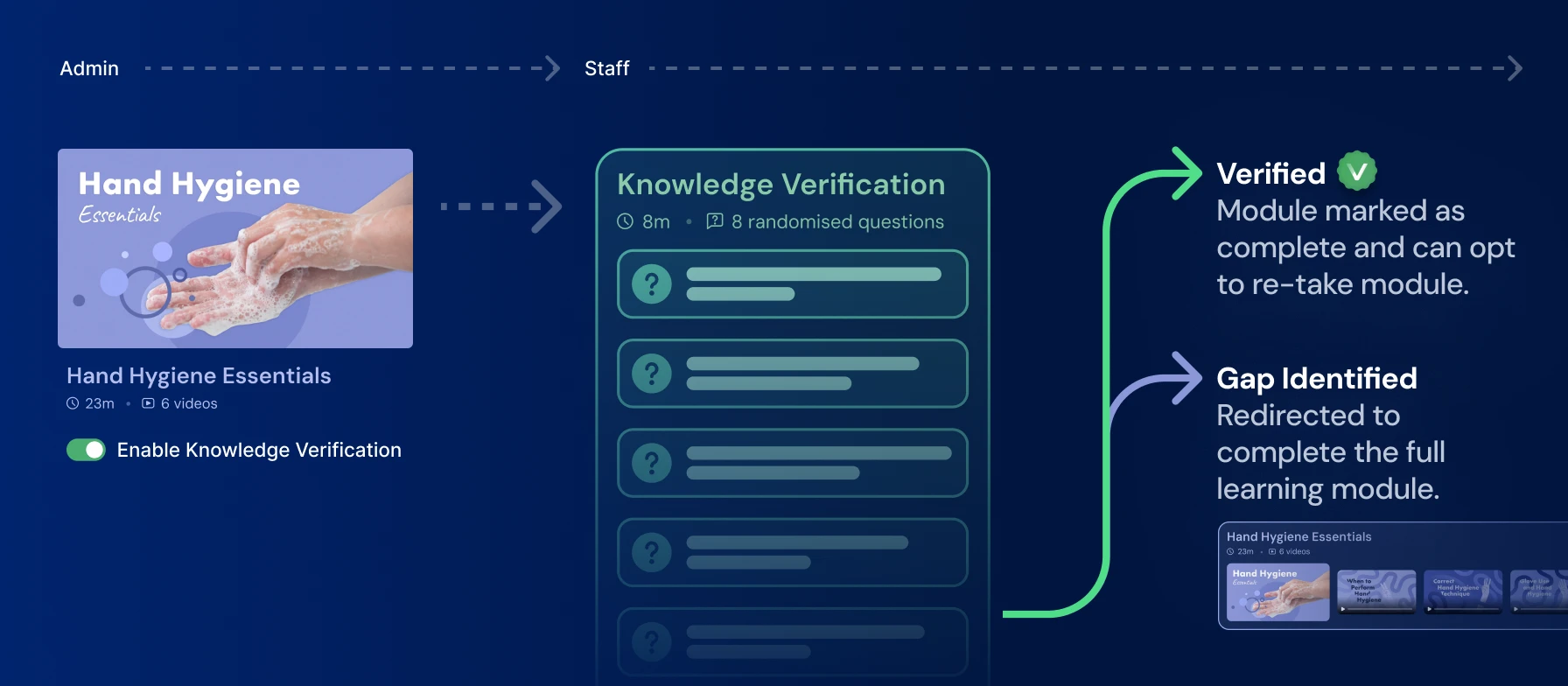
Experienced healthcare professionals and workers spend thousands of hours repeating training they already understand. Knowledge Verification is a structured, summative pre-assessment that recognises existing knowledge, reducing unnecessary repetition while maintaining clear compliance records and focusing training effort where it's actually needed.

Eliminate unnecessary repeat training, redirect staff to higher-value learning, and free up time to apply their skills where it matters most.

Auditors demand evidence of comprehension, not just completion. Get clear proof of what your staff actually know.

Get point-in-time and historical trend data on your people's strengths and where actionable opportunities for improvement lie.

When Knowledge Verification is enabled on a module, learners follow a clear, structured pathway.
When a KV-enabled module is assigned, the learner is prompted to attempt a short Knowledge Verification assessment before the full module.
Learners can always choose to go straight to the full module instead.
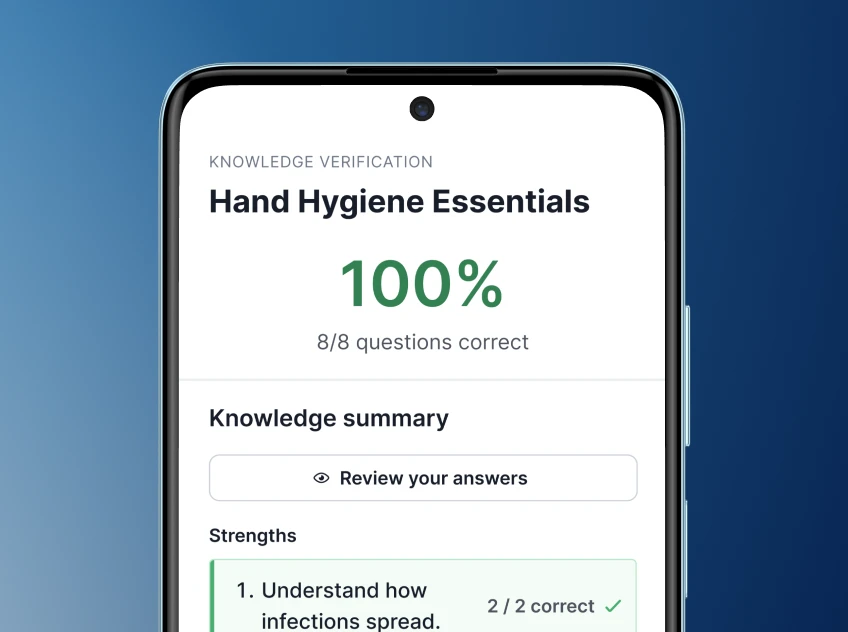
Randomised questions are drawn from a curated bank, covering each of the module's learning outcomes. No backtracking is allowed and feedback is shown only after completion.
One attempt per assessment, with a visible timer throughout.
Verified : Learning outcomes have been met, training is marked completed.
Gaps Identified: Proceed to complete training module. At completion of the module, training is marked as completed and evidenced in compliance reporting.
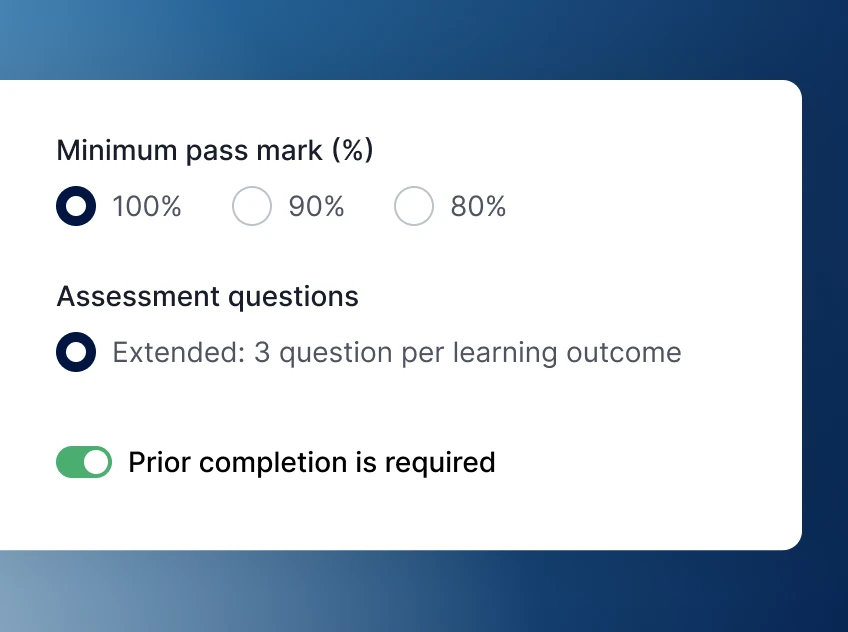
Organisations have full control over how Knowledge Verification is applied.
Nurse Unit Manager
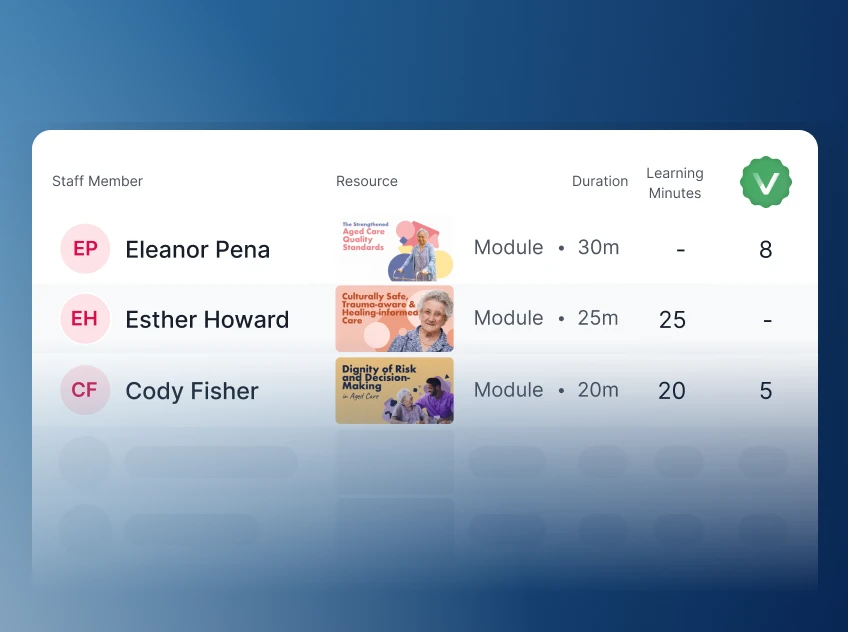
Learning records clearly distinguish between traditional completions and Knowledge Verification. Payroll reports include a KV indicator and recorded duration so organisations can calculate payment accurately, whether staff complete KV only or KV followed by the full module.
Learners can always opt to complete the full module instead. Feedback is shown only after completion, and language is framed around empowerment, not punishment. Staff feel trusted rather than tested.
See how Knowledge Verification strengthens every aspect of mandatory training, from the evidence you collect to the time your staff spend.
| With Knowledge Verification | Current mandatory training | |
|---|---|---|
| Evidence of learning |
| Completion only |
| Assessment rigour |
| Unlimited attempts, no pass threshold |
| Training time |
| Full module every cycle |
| Staff engagement |
| Click-through behaviour common |
| Workforce insights |
| Completion rates only |
| Payroll reporting |
| Standard completion records |

Every KV-eligible module passes a structured risk-assessment gate. Questions are mapped to learning outcomes, aligned to Bloom's taxonomy, and developed by Ausmed's Content and Governance team. KV is designed to sit within your broader training system, not replace it.
Model the time and cost savings Knowledge Verification could deliver for your organisation.
Figures are indicative. Real results depend on your context and assumptions.
Book a demo to see how Knowledge Verification can reduce mandatory training time, improve staff engagement, and strengthen your evidence of workforce knowledge, all within the Ausmed LMS.
Staff often spend hours repeating training they already understand, creating unnecessary wage costs and reducing time available for providing care. Knowledge Verification allows staff to demonstrate their existing knowledge upfront. When knowledge is confirmed, the assignment is completed without repeating the full module, reducing unnecessary repetition while maintaining a clear compliance record.
The time saved depends on pass rates, the number of modules enabled for KV, and assessment duration. For example, a 28-minute module with a 10-minute KV assessment results in approximately 18 minutes saved per staff member who passes, roughly 64% time saving for that assignment. Organisations can model different scenarios using the Knowledge Verification Savings Calculator.
Organisations can enable or disable KV per module, set custom pass marks (e.g. 80%, 90%, 100%), configure 2–4 questions per learning outcome, and optionally require staff to complete the full module once before KV unlocks. This ensures KV aligns with your organisation's governance framework and risk appetite.
No. Passing KV confirms that knowledge is aligned with the module's learning outcomes. It does not assess psychomotor skills, replace workplace observation, or substitute formal competency frameworks. KV sits at the "knowledge" stage of the capability pathway, providing stronger evidence than completion-only models while recognising that competence requires additional assessment methods.
Several design controls reduce the risk of gaming or misuse. Randomised question sets are drawn from a question bank for each learning outcome. Learners cannot backtrack between questions and feedback is provided only after completion. A visible timer is present during the assessment. Learning records clearly show the completion method and payroll reporting includes KV participation details.
KV strengthens audit defensibility by introducing structured, summative verification of knowledge with defined pass marks, randomised question banks, and clear completion records. It provides more evidence of comprehension than traditional completion-only models. KV is most defensible when positioned as part of a broader training system rather than as a standalone replacement. Ausmed does not guarantee regulatory or audit outcomes.
Ausmed's Content team is prioritising approximately 25 high-usage, high-value modules. Initial focus areas include softer skills topics, professional conduct, and standards-related modules. Higher-risk clinical topics are excluded initially. The goal is to expand KV coverage across eligible modules in the training library over 2026, subject to governance processes and evaluation of use.
KV time is captured in reporting to support payroll processes. The payroll report includes a KV indicator identifying that the assignment was completed through Knowledge Verification, along with the recorded KV duration. This allows organisations to calculate payment accurately whether staff complete KV only, or KV followed by the full module.
Ausmed Education is a Trusted Information Partner of Healthdirect Australia. Verify here.