
The Aged Care Worker Registration Scheme is one of the most significant workforce-compliance changes the sector has seen in decades. As at May 2026, the scheme is still being designed and consulted on, but the regulatory direction and the surrounding worker-screening obligations are already locked in. The next two years will reshape recruitment, onboarding, training, evidence, re-registration and exit for every aged care provider.
This guide is for the people whose work the scheme will reshape: CPOs and HR Managers who own the workforce process, Heads of Quality and Risk who own the compliance posture, and L&D leaders who own the training and evidence trail. It covers what the scheme actually requires, what is confirmed for 2026, who is in scope, the L&D operational impact, and five practical things to do in your systems today to be registration-ready.
What the scheme is
The Aged Care Worker Registration Scheme is a national registration framework being developed by the Department of Health, Disability and Ageing and the Aged Care Quality and Safety Commission, in response to recommendations of the Royal Commission into Aged Care Quality and Safety (2021). Once operational, it will require direct-care workers in the aged care sector to be registered, with registration tied to demonstrated training, screening, and competence appropriate to their role (Department of Health, Disability and Ageing, 2025a).
The scheme sits inside the broader regulatory framework established by the Aged Care Act 2024, which commenced on 1 November 2025, and is operationalised through the Strengthened Aged Care Quality Standards (Department of Health, Disability and Ageing, 2025b; Aged Care Quality and Safety Commission, 2025). It is not a replacement for existing worker screening or training requirements. It is an additional layer that consolidates evidence at the individual worker level, making each worker's compliance status portable and visible across providers.
What is confirmed as at May 2026
A few things are settled, and the rest is still being designed.
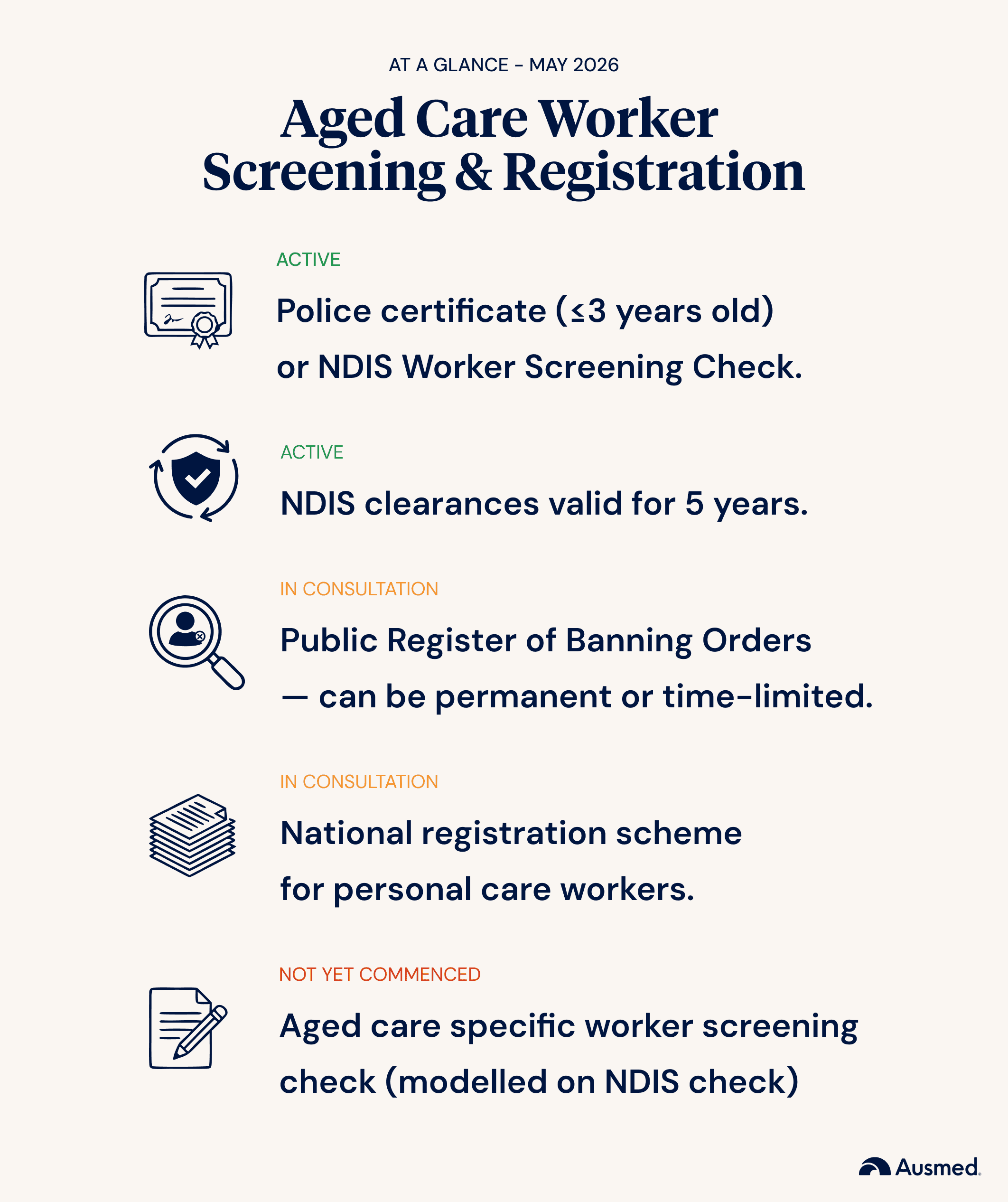
Confirmed. New worker screening obligations applied from 1 November 2025. Aged care providers must now ensure that every worker holds either a police certificate (no older than three years and not recording certain offences) or a current NDIS Worker Screening Check (Department of Health, Disability and Ageing, 2025c). NDIS Worker Screening Clearances are valid for five years (NDIS Quality and Safeguards Commission, 2025). Providers must keep records of every worker's screening (name, date of birth, address, clearance details, statutory declarations) for seven years, even after the worker leaves (Department of Health, Disability and Ageing, 2025c).
Confirmed. The Aged Care Quality and Safety Commission maintains a public Register of Banning Orders. Banning orders can be made against current or former workers, responsible persons or providers where the Commissioner determines they are unsuitable to be involved in aged care, and a banning order can be permanent or for a specific period (Aged Care Quality and Safety Commission, 2024).
In design. Public consultation on a national registration scheme for personal care workers ran from 18 February to 17 April 2025. Sector feedback included strong support for a phased rollout, harmonised requirements between personal care and disability support workers, and a clear definition of personal care work in aged care (Department of Health, Disability and Ageing, 2025d).
Planned but not yet commenced. The Department has signalled that an aged care worker screening process modelled on the NDIS Worker Screening Check will be introduced for the aged care sector. This process is not expected to commence before mid-2026 (Department of Health, Disability and Ageing, 2025e).
The practical implication for providers in 2026: the worker-screening floor has already shifted, the personal-care-worker registration framework is in design, and the consolidated registration system that will sit on top of both is still being built. Providers who use 2026 to consolidate evidence and tighten their workflows will be ready when the registration system goes live. Providers who wait for final design will not.
Who is in scope
Registered Nurses and Enrolled Nurses are already registered nationally through the Australian Health Practitioner Regulation Agency (AHPRA, 2025), and the new scheme will sit alongside their existing registration. The expected scope of the new framework includes:
- Personal Care Workers
- Other direct-care workers identified through the consultation process
- Allied health professionals delivering aged care services (where not already covered by an AHPRA profession)
Roles outside the proposed scope typically include hospitality, administration, lifestyle and recreation, and volunteers, unless they perform direct-care tasks. Final role definitions are being finalised through the consultation process.
The registration requirement is expected to apply regardless of employment type: full-time, part-time, casual, and agency workers are all in scope. Confirm role-level scope against the most recent Department publications before formal communications to your workforce.
Workforce screening and training implications
Registration is expected to require, at minimum, evidence of:
- Current worker screening (police certificate or NDIS Worker Screening Clearance, per the November 2025 rules)
- Completion of mandatory orientation modules (e.g. the NDIS Worker Orientation Module or an aged-care equivalent)
- Role-appropriate training under the Strengthened Aged Care Quality Standards (Aged Care Quality and Safety Commission, 2025)
- Ongoing professional development cadence
- Absence of regulatory exclusions, including banning orders recorded by the Aged Care Quality and Safety Commission (Aged Care Quality and Safety Commission, 2024)
For existing workers, this evidence already exists in fragmented form: training records in the LMS, screening certificates in HR files, professional development records in personal logbooks. The registration scheme will require this evidence to be consolidated, validated, and portable.
For new workers, registration will increasingly become a pre-employment expectation. Providers who can confirm registration status before a worker walks in the door will have a meaningful onboarding advantage.
The L&D operational impact
The scheme is shaping five L&D workflows.
1. Onboarding evidence capture. New starters will arrive with a registration credential. The LMS needs to ingest that credential, validate currency, and pre-populate the new starter's training record where applicable. Re-training a worker on content they already have verified evidence for is wasteful and a worker-experience signal.
2. Re-registration cadence. Workers will need to re-register on a defined cadence. The LMS becomes the source of professional-development evidence for re-registration. Workers will start asking their employer for re-registration evidence packs.
3. Evidence-pack production. Quality and L&D teams will need to produce per-worker evidence packs on demand, both for the worker (for their own registration) and for the Commission (for compliance reporting). This is operationally the same workflow as audit-evidence-pack production, with one additional consumer: the worker.
4. Portable learning records. Tools like Ausmed Passport will become more strategically important. Workers want their training to follow them across employers. Employers want to recognise prior learning from other providers without re-training. Portable learning records solve both sides.
5. Workforce screening integration. Screening status changes (a lapsed police certificate, a new banning order on the Register) need to flow from screening systems to the LMS and to the registration record. Integration that previously was a nice-to-have becomes operational, particularly given the seven-year record-keeping obligation introduced on 1 November 2025 (Department of Health, Disability and Ageing, 2025c).
Five things to do in your systems today
If your provider has not yet planned for the scheme's operational implications, five practical steps are worth taking in the next 90 days.
1. Audit your current evidence completeness. For each direct-care worker, can you produce a current evidence pack covering screening, mandatory training completion, role-appropriate training under the Strengthened Standards, and ongoing professional development? Note where the data is missing or fragmented.
2. Map your workforce screening data flow. Where are screening certificates stored? How is currency tracked? Who is alerted when a check is about to lapse? If the answer involves a spreadsheet and a calendar reminder, the system needs upgrading.
3. Confirm your LMS produces per-worker evidence packs. This is the production workflow for both audit evidence and registration evidence. If your LMS cannot produce them on demand, talk to your vendor about the timeline.
4. Start the portable learning-record conversation. Workers will increasingly expect their training to be portable. Tools like Ausmed Passport let workers carry their learning across employers. Adopting them early signals respect for worker experience and reduces re-training burden when you hire from another provider.
5. Plan the change-management. Workers will have questions: What do I need to do? Will my employer help? What happens if my registration lapses? The communications plan for the scheme is as important as the systems plan.
How the scheme connects to the Strengthened Standards
The scheme and the Standards are interlocking, not duplicative. The Standards define what training a worker needs to be competent for their role (Aged Care Quality and Safety Commission, 2025). The scheme will create a portable evidence record that the worker is, in fact, competent. The Standards live with the provider. The scheme lives with the worker.
For providers, the implication is that the same training record that satisfies the Standards (via audit-evidence packs) will satisfy the scheme (via per-worker registration packs). The workflow is the same. The consumers are different.
This is good news. Investments in audit-evidence production also improve registration readiness. The two regulatory frameworks reward the same operational maturity.
Where most providers will be in 2026
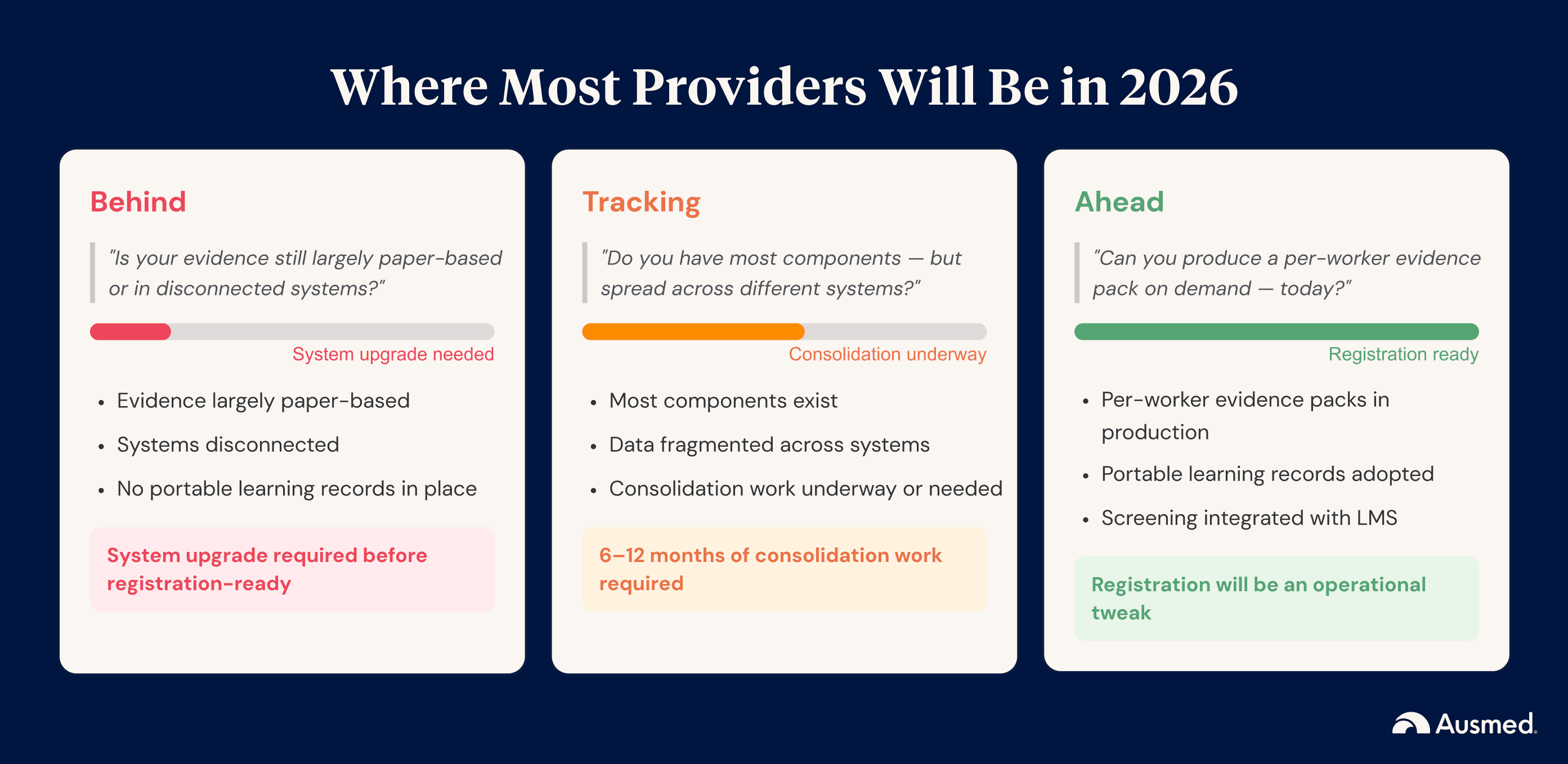
Most providers entering the second half of 2026 will be in one of three positions:
- Ahead. Already producing per-worker evidence packs, portable learning records adopted, screening integrated. Registration will be an operational tweak.
- Tracking. Have most components, but they are fragmented across systems. Registration will require six to twelve months of consolidation work.
- Behind. Evidence is largely paper-based or in disconnected systems. Registration will require a system upgrade.
The gap between "Tracking" and "Behind" is closable in 2026 with deliberate effort. The gap between "Behind" and registration-ready, without deliberate effort, is not.
References
- Aged Care Quality and Safety Commission (2024) Register of Banning Orders. Available at: ACQSC banning orders (Accessed: 26 May 2026).
- Aged Care Quality and Safety Commission (2025) Strengthened Aged Care Quality Standards. Available at: ACQSC Strengthened Standards (Accessed: 26 May 2026).
- Australian Health Practitioner Regulation Agency (AHPRA) (2025) Nursing and Midwifery Board of Australia: Registration. Available at: NMBA registration (Accessed: 26 May 2026).
- Department of Health, Disability and Ageing (2025a) Australian Government progressing a national worker registration scheme for aged care workers. Available at: Minister media release (Accessed: 26 May 2026).
- Department of Health, Disability and Ageing (2025b) About the new rights-based Aged Care Act. Available at: DoHDA new Act overview (Accessed: 26 May 2026).
- Department of Health, Disability and Ageing (2025c) Aged Care Worker Screening: Guidance material. Available at: DoHDA worker screening guidance (Accessed: 26 May 2026).
- Department of Health, Disability and Ageing (2025d) Consultation summary report on a national registration scheme to support personal care workers in aged care. Available at: DoHDA consultation summary (Accessed: 26 May 2026).
- Department of Health, Disability and Ageing (2025e) New ways of working in aged care. Available at: DoHDA workforce reforms (Accessed: 26 May 2026).
- NDIS Quality and Safeguards Commission (2025) Worker screening. Available at: NDIS worker screening (Accessed: 26 May 2026).
- Royal Commission into Aged Care Quality and Safety (2021) Final Report: Care, Dignity and Respect. Available at: Royal Commission final report (Accessed: 26 May 2026).