
On 1 June 2026, the Australian Commission on Safety and Quality in Health Care (ACSQHC) released a new National Model for Clinical Governance (ACSQHC 2026a). It replaces the 2017 framework that has shaped hospital governance for nearly a decade, and it is the most significant change to clinical governance expectations in that time.
The model sets out what clinical governance is for: the organisational culture, systems and structures that let a health service deliver care that is consistently high quality and improving. The Commission defines high-quality care as person-centred, safe, effective, accessible and integrated, delivered in a way that is equitable, efficient and sustainable (ACSQHC 2026a).
For hospital and health services leaders this is more than a document refresh. The model moves the centre of gravity from meeting accreditation requirements to building a culture that delivers high-quality care every day, and it sharpens the personal accountability of directors and executives for the safety and quality of that care.
What has changed
The 2017 framework was built around accreditation. The 2026 model is built around culture and outcomes (ACSQHC 2026a). Five shifts define the difference.
The first is from compliance to culture. The model asks health services to build a whole-of-organisation culture for consistently high-quality care, rather than to satisfy a checklist at accreditation time.
The second is outcomes at the centre. Care is governed around the outcomes and experience that matter to patients, not the volume of process completed.
The third is sharper accountability. The model is explicit that boards and executives are accountable for establishing, maintaining and improving the systems that deliver high-quality care.
The fourth is workforce wellbeing as a governance issue. The psychosocial and cultural safety of staff is now a board responsibility, framed alongside existing work health and safety duties.
The fifth is digital and AI oversight. Boards are expected to govern digital tools and the safe, ethical use of automated systems, including artificial intelligence in clinical decision-making (ACSQHC 2026a).
The six foundations
The model structures clinical governance into six connected foundations (ACSQHC 2026a). They are interdependent, and leadership is the enabler that holds them together. Each foundation comes with examples of good practice and warning signs that should alert a board to weakness in its systems.
| Foundation | What it covers |
|---|---|
| 1. Leading systems and organisational culture | A clear strategy for high-quality care, board capability, oversight of safety culture, and accountability for cultural safety and digital and AI-enabled care |
| 2. Partnering with patients, carers and consumers | Consumer partnership at every level, person-centred care, open disclosure, and acting on patient-reported experience and outcomes |
| 3. Building a healthy workforce culture | A physically, psychosocially and culturally safe workplace, a just and learning culture, speak-up systems, and workforce planning and wellbeing |
| 4. Enabling high-quality and integrated clinical practice | Evidence-based care, coordinated transitions of care, credentialing and scope of practice, peer review, and clinician leadership |
| 5. Managing and reducing risk | A board-set risk appetite, oversight of clinical, financial, digital and operational risk, incident investigation, and cyber and AI risk |
| 6. Using data for better care | Decisions based on data, comparative and equity data, data sovereignty for Aboriginal and Torres Strait Islander communities, and governance of data from digital systems |
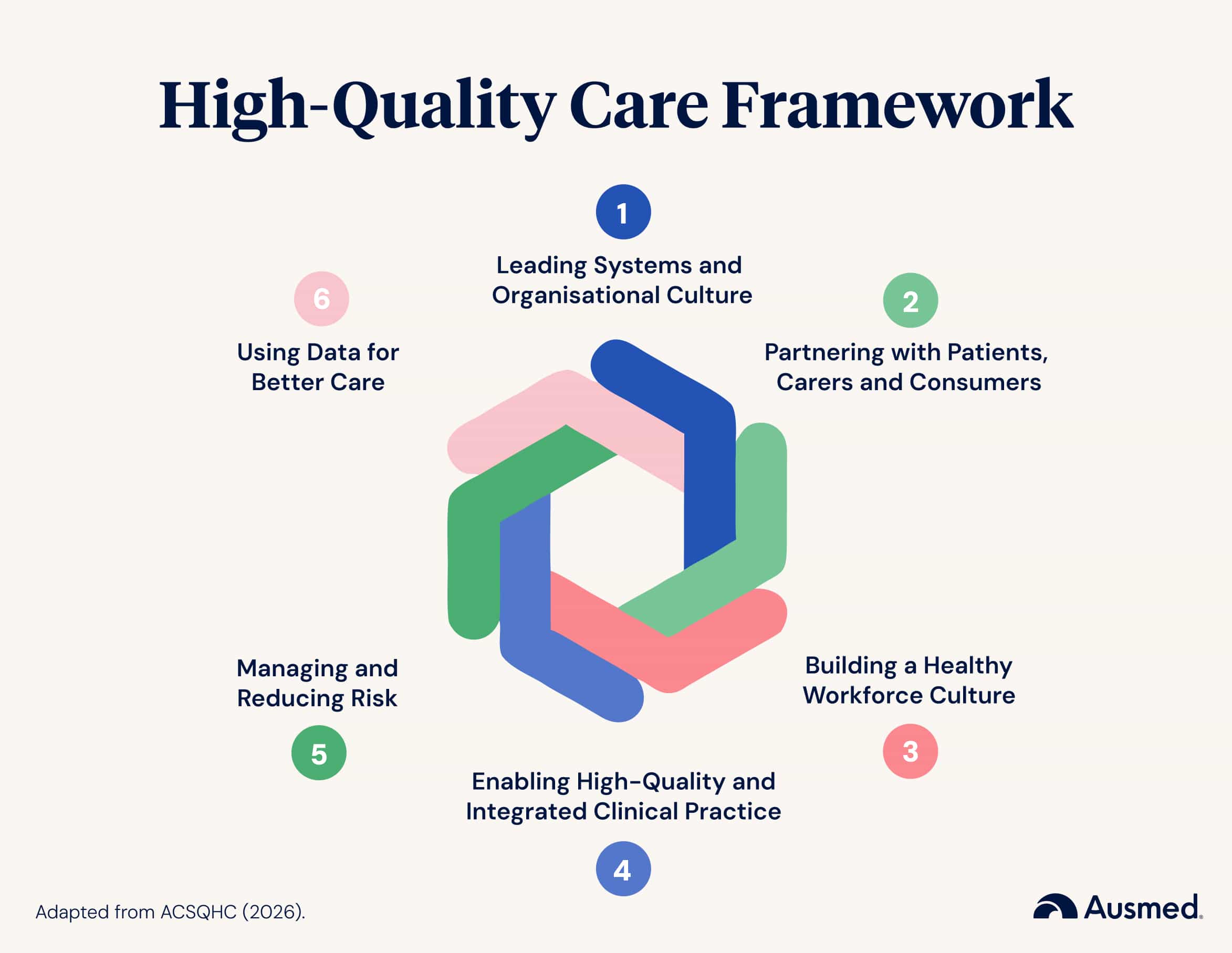
Source: ACSQHC 2026a.
Why it matters for Hospital and Health Services specifically
Two reasons make this urgent for hospitals.
The first is accreditation. The Commission has confirmed that the six foundations will form the structure of the Clinical Governance Standard in the third edition of the NSQHS Standards, currently in development (ACSQHC 2026c). Health services that bring their governance into line with the six foundations now will face a smoother transition at their next accreditation cycle, instead of rewriting board charters, committee terms of reference and risk registers under time pressure later.
The second is accountability. The stronger duties on directors and executives intersect with existing law: directors’ and officers’ duties, work health and safety obligations for psychosocial hazards, privacy and data-security law, and open-disclosure requirements. A governance framework that reads well on paper but is not reflected in your charters, risk registers and WHS systems is now a source of legal risk rather than protection.
The part that’s easy to miss
Three of the six foundations rest directly on the capability of your workforce. A healthy workforce culture (Foundation 3), high-quality clinical practice (Foundation 4), and the data to govern both (Foundation 6) all depend on what staff know, whether they apply it consistently, and whether you can prove it.
This is the point Avedis Donabedian made in 1966 and it still holds (Donabedian 1966). Workforce is structure: the staffing, knowledge and skills that decide what process and outcomes are possible. The Quality in Australian Health Care Study found that 16.6% of hospital admissions involved an adverse event, and just over half were judged preventable (Wilson et al. 1995). Three decades on, preventable harm still traces back to workforce capability more often than to any other single cause.
The model makes this a board-level concern. If boards are accountable for a psychosocially safe workforce and for evidence-based practice, they need to see capability, not assume it. That means current, Australian-specific clinical education, policy that reaches the ward, and data a board can read.
Where to start
The model is short and principles-based by design, which makes it readable in an afternoon. Start there. Read the model and the accompanying practical guide to implementation, both available from the ACSQHC at safetyandquality.gov.au/nmcg (ACSQHC 2026a; ACSQHC 2026b). The practical guide sets out five high-level steps and companion tools, including an implementation maturity scale and a planning template, to help you plan the work (ACSQHC 2026b).
Then look at your own instruments. Do your board agendas, committee terms of reference and risk registers reflect the six foundations, or the 2017 framework they replace? The organisations that treat this as a governance question now, rather than an accreditation task later, will be the ones ready when the third-edition standards arrive.
Clinical governance has always turned on one question: can you assure the people you serve that their care is safe and improving? The 2026 model raises the bar on how you answer it, and puts that answer squarely on the board’s desk.
References
Australian Commission on Safety and Quality in Health Care (ACSQHC) 2026a, National Model for Clinical Governance, ACSQHC, Sydney, viewed 30 July 2026, https://www.safetyandquality.gov.au/clinical-topics/clinical-governance/2026-national-model.
Australian Commission on Safety and Quality in Health Care (ACSQHC) 2026b, 2026 National Model for Clinical Governance: Practical guide to implementation, ACSQHC, Sydney, viewed 30 July 2026, https://www.safetyandquality.gov.au/clinical-topics/clinical-governance/2026-national-model-practical-guide-implementation.
Australian Commission on Safety and Quality in Health Care (ACSQHC) 2026c, Reshaping Australia’s approach to clinical governance, media release, ACSQHC, Sydney.
Donabedian, A 1966, ‘Evaluating the quality of medical care’, The Milbank Memorial Fund Quarterly, vol. 44, no. 3, pp. 166-206.
Wilson, RM, Runciman, WB, Gibberd, RW, Harrison, BT, Newby, L & Hamilton, JD 1995, ‘The quality in Australian health care study’, Medical Journal of Australia, vol. 163, no. 9, pp. 458-471.