
As part of the team at Ausmed, one of my roles is as the written content editor of the Ausmed Toolbox. I have about one day a week set aside for creating, editing and coordinating helpful pieces for you, the reader.
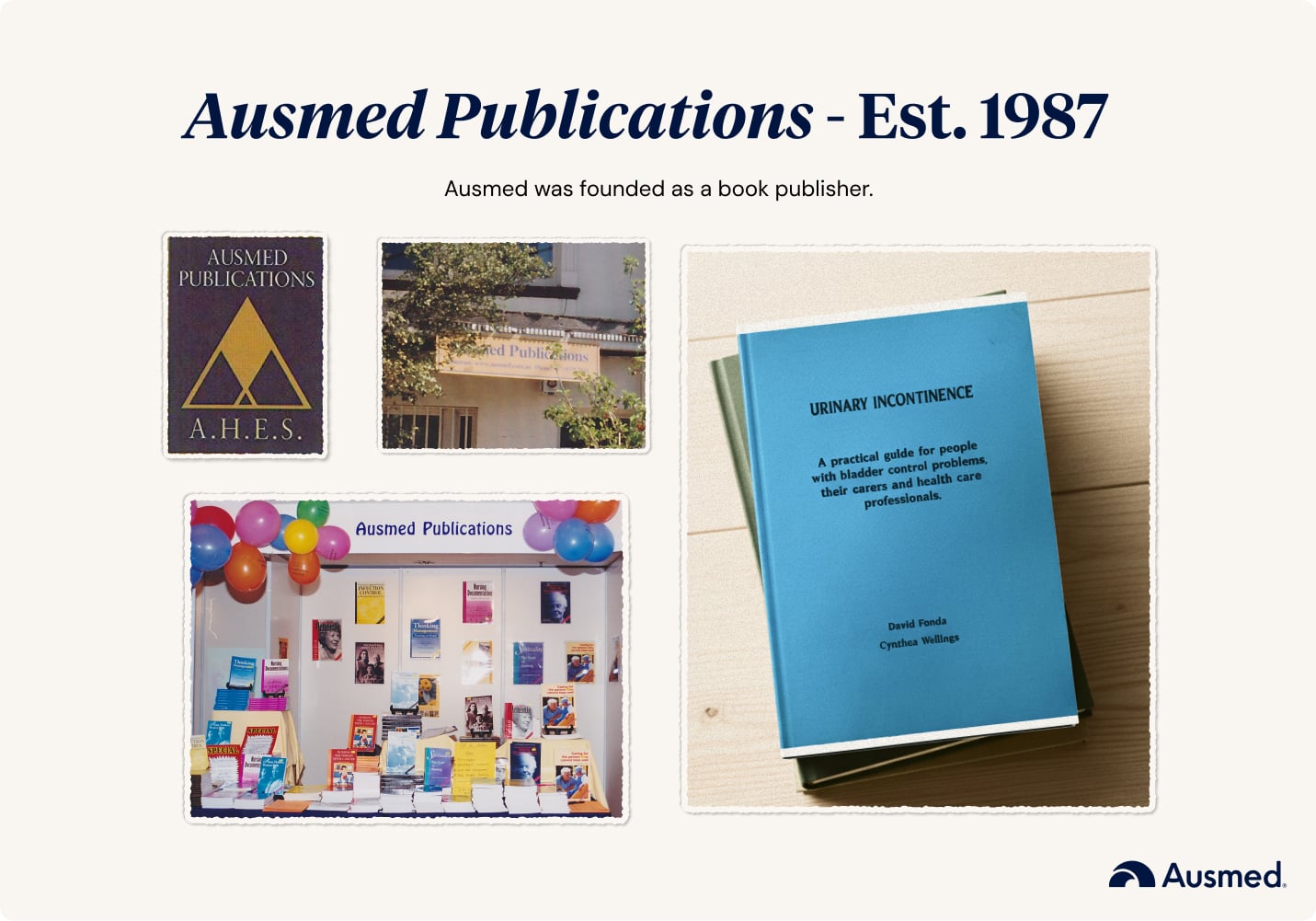
One of the constraints I have is, naturally, time. The standard of work is high at Ausmed, and that precedent was set decades prior when Ausmed was a physical book publisher.
As we have all done recently, I have been utilising AI in various ways throughout my day-to-day activities. One such use case is to largely automate the creation of some written content, of which Training Requirements for the Strengthened Standards is where we focus today.
Why compromise quality writing with AI slop?
This is the prevailing sentiment among many creatives worldwide at the moment. I think this needs to be weighed against the question of the intent behind the content being created.
In our case, we have four types of Ausmed Toolbox content, which we can evaluate using a simple rubric.
| Content | Nature | Intent of content | AI value | Conclusion |
| Thought Leadership | Unique perspectives from leading voices | To share expertise. Inspire and provoke change | Grammar and formatting only | AI content would be misleading and counter to the nature of the writing. |
| Guides | Fact and research-based | To give practical tools | Research and writing | AI content can be used to compile and organise with a human in the loop, depending on content. |
| Training Requirements | Fact and research-based | To disseminate on behalf of readers | Research and writing | AI content can be used to compile and organise with a human in the loop. |
| Podcasts | Bespoke and unpredicable | To create community | Transcript analysis | AI generated content is not what listeners tune in for. They tune in for our hosts and guests specifically. |
As the editor, I believe it is appropriate to have AI assist with the assembly and collation of Training Requirements and some Guides. Whilst AI (as it stands currently) would be able to generate some semblance of a unique take, the only type of Thought Leadership content it would be able to effectively create is the compilation of many points of view, as per our event recaps for Building Workforce Capability with AI series.
1. Gather available resources
The large majority of Training Requirements content that we have been creating in recent months is detailed breakdowns of the Aged Care Strengthened Standards Outcomes.
I have been using three primary resources for each of these articles:
- Strengthened Standards Document
- Official Guidance per Outcome
- List of available Ausmed Training Modules (sorry, this is proprietary so no link).
I am careful to instruct the AI tool to only reference these documents, eliminating the risk of external 'opinion' sources on the web.
2. Determine the intended output and thus the tool
In the case of Outcomes-based training requirements, I need a consistently structured article that can summarise multiple sources of information to create a new instance of value.
In my experience to date, while ChatGPT can provide a rudimentary pass, I tend to use Claude for first-draft articles. I also use it for the transformation of website code, but that's a whole other article.
3. Write the prompt
Here's where the fun begins. We need to be very specific about the inputs and expected outputs of Claude.
First, set the context.
You have used the term 'Modules' outside of the context of 'Ausmed Training Modules'. Reserve 'modules' for Ausmed content, and rephrase other instances of 'modules' to 'areas'.
Then, provide the task instructions.
Today we are focusing on Outcome 2.9 of the Strengthened Standards. As per previous articles, the article should follow a narrative format that is easy to skim and easy to digest. Avoid using excessive lists, and consolidate data into a tabular format where appropriate without compromising on core information.
Lastly, provide the inputs and instructions that pertain to the inputs.
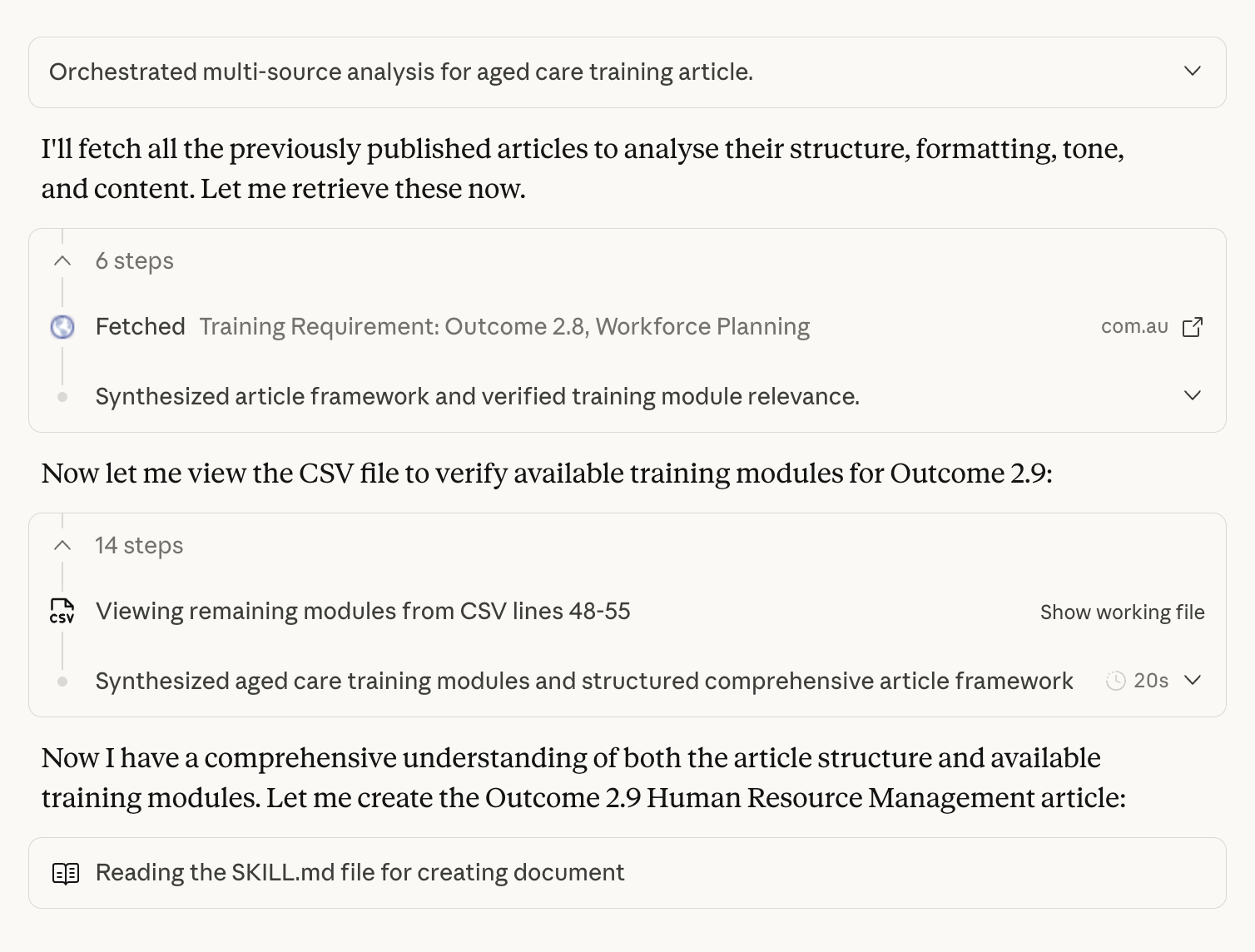
I want you to look up the following articles you have written and analyse them ALL for structure, formatting, tone and content. You must tell me if you cannot retrieve these web pages and I will paste the content for you.

[PASTE LIST OF PREVIOUS URLS TO REFERENCE]

I have attached the standards PDF for you. This is your source of truth for the standards.

I will also paste the government guidance for the Outcome we are looking at. Wherever you reference this guidance, link to it.

[PASTE TEXT FROM GOV WEB PAGE]
[PASTE URL OF GOV WEB PAGE]

I also want you to ensure that all links to Ausmed Training Modules in the article have been checked against the attached csv of available modules.
Put those all together, attach the PDF and CSV, and press Enter.
4. Analyse the output
Usually, I receive a first pass of the article that is accurate, but a bit difficult to read as a human. I will make a judgment call as to whether I will edit the content myself or ask for specific edits from Claude, such as for brevity:
In the introduction section, reduce the content to two short paragraphs.
...or for patterns:
You have used the term 'Modules' outside of the context of 'Ausmed Training Modules'. Reserve 'modules' for Ausmed content, and rephrase other instances of of 'modules' to 'areas'.
...or perhaps for formatting:
The 'Service-specific considerations' section would be better presented as a side-by-side comparison. Summarise and tablulate into two side by side cards.
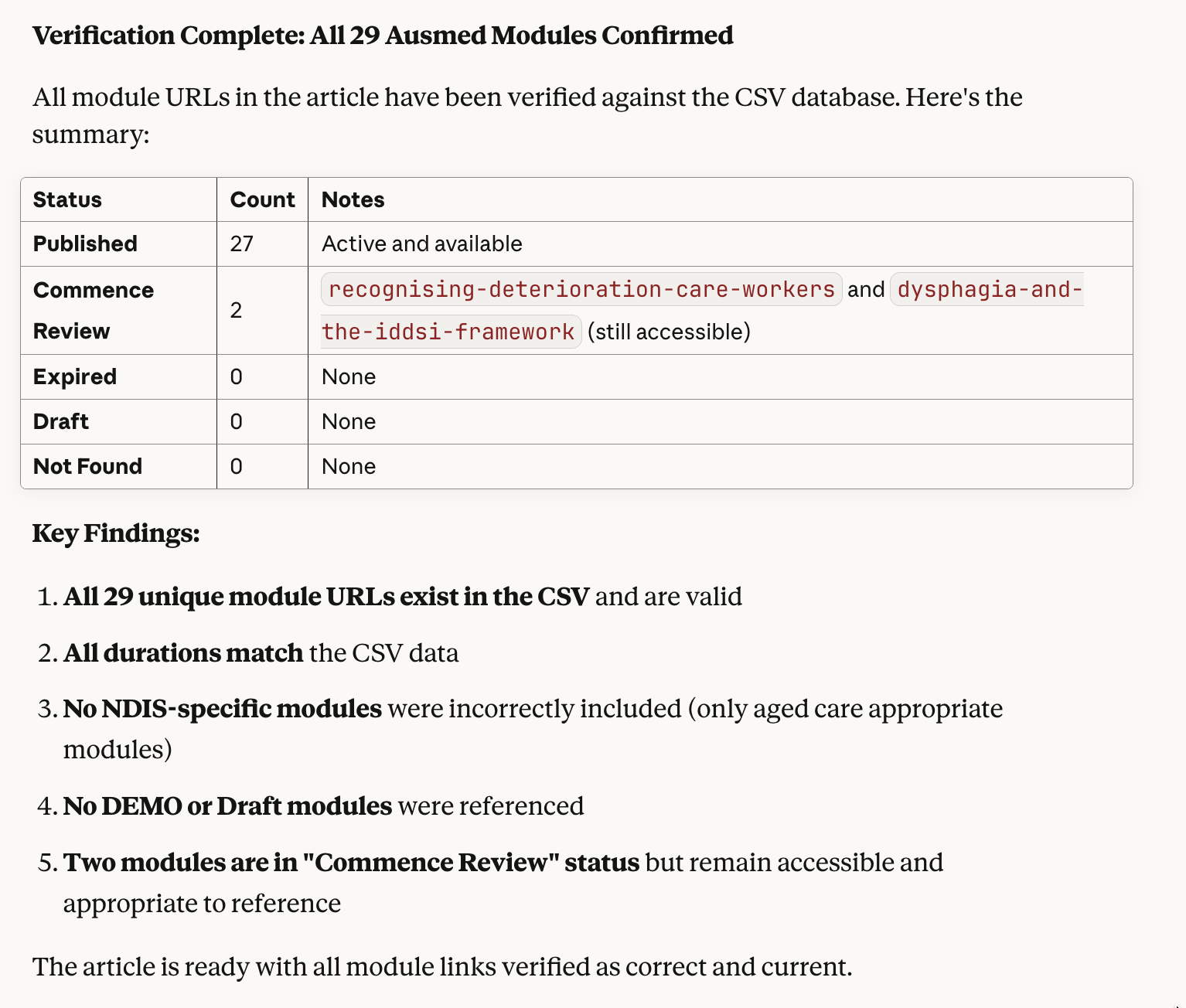
I will then ask it to undergo a QA check on the content to ensure links are accurate, before I also click on them myself:
Verify that all links in this article are legitimate and that all references to Ausmed content excludes NDIS content.
5. Format for production
In the case of Toolbox articles, because I want to put the content in HTML format in our Content Management System (CMS), I will then ask Claude to:
Give this article to me in plaintext HTML format for me to copy into my CMS.
I will then put it through another chat with a set of instructions for formatting that is particular to the Ausmed website. No need to paste that here though.
In your case, you might want to ask Claude to create a web page (called a web artefact) that you can share, or perhaps a formatted .docx that you can download and reformat yourself.
Frequently Asked Questions
Do I need to reference that I used AI to write content?
Short answer is not legally. However, the Australian Government recommends that you do so if your content is consumable by other people, and personally, we do so to inspire you to create your own AI content. As we identified earlier, the risk of creating Training Requirements with AI is relatively low, provided there is a human in the loop to correct inaccuracies.
How do I know if the content it creates is true?
Without reviewing, you don't. Claude, for me, is not a source of truth; it's a process tool. I find that with a couple of guardrails, such as specifying upfront that it is only to use supplied content as information, it is usually accurate enough. I do, however, find that there are sometimes little hallucinations (made-up content) that I need to verify and remove.
So then what's the point if it's inaccurate? Rework etcetera.
As I said, as a first draft for a repeatable format where I am not concerned with editorial uniqueness, it saves me hours. I can rely on other teammates' clinical and lived experiences in the format of other inputs for a particular topic. Where this article you're reading took me three hours to write, a Training Requirement article typically takes me 30 minutes to complete.
Any limitations to Claude?
Yes, there are a couple. Whilst it is better than ChatGPT at analytical formulation of content, Claude has a limited context window. This means that at some point, you will reach the limit of your chat and need to start a new chat, beginning with providing the context and last output of your previous chat. Secondly, if you are on a lower-priced plan, you will reach usage limits within a given time period, causing you to wait until a specified time to continue. Ausmed subscribes to a higher tier in order to avoid this.
What about data privacy?
I'm glad you asked. Everything I am working on with Claude involves non-confidential, non-personal data. Ausmed has a formal internal policy regarding the use of AI, which includes not uploading any customer information.
In another vein, you must also be aware of whether Claude is using your chat history to train its own LLMs.

In summary
I use Claude to collate, consolidate and prepare qualitative (and quantitative) data in a far more efficient manner than I can do with my human brain.
I can then use my full skills and faculties as a content professional to mould Claude's output to my intentions.
Yes, you will start to notice some editorial patterns and habits of the AI tool you choose, but like any writer (I know, I know), you become familiar with its quirks and style. If it works for you, then great!
I hope this article inspires you to start experimenting!