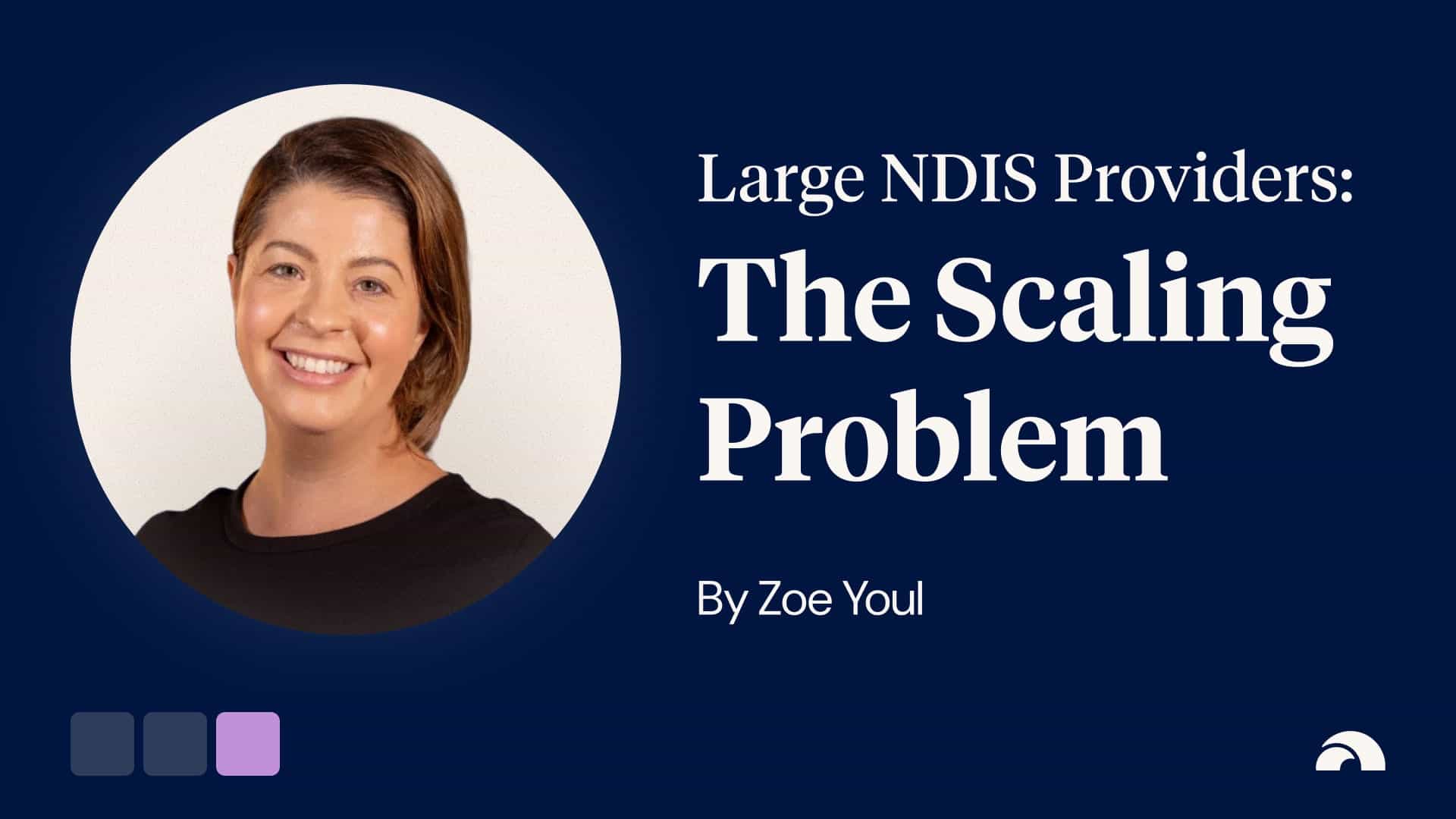
It might surprise you to learn that, in a scheme with more than 750,000 active participants, a significant share of service delivery sits with a relatively small group of about 300 large providers.
These ~300 providers are Australia’s large NDIS providers.
Unlike the very small providers, who employ a small amount of staff (on average only seven per provider), only and can rely on 1:1 relationships to implement change, large providers need scalable, efficient systems.
The complex reform program already underway, combined with constant funding-model changes, therefore creates a macro-level priority for large providers to refocus on: delivering systematic transformation of their operating model at scale.
Systematic transformation at scale
In a sector where approximately 66% of total NDIS expenditure is on employing people to provide participant supports, workforce capability will always sit at the centre of transformation programs.
Workforce *anything* is therefore the highest leverage area for a provider to focus on.
For large disability providers, the workforce is not just a cost to manage. It is a core operating asset and a major source of service quality and consistency. Yet it is also a significant risk if capability is not systematically built and made visible.
The mismatch
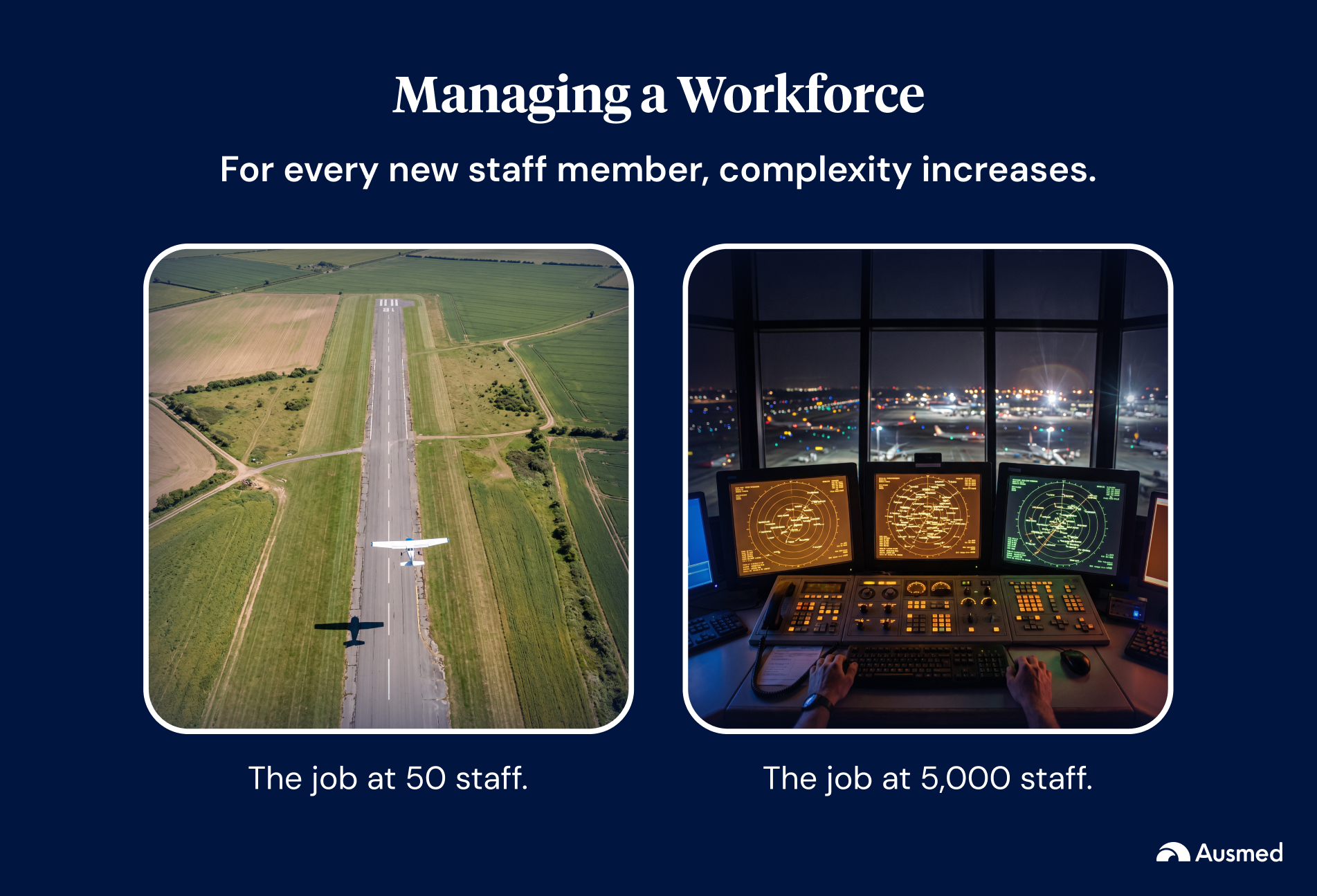
Large NDIS providers are not simply “bigger versions” of smaller ones.
They are managing a different level of complexity.
That complexity doesn’t just stem from sheer workforce size. It is compounded by many other complicating factors, including:
- Number of participants
- Number of sites/service locations (e.g., SIL/SDA/ day program homes, also if services are for remotely located participants)
- Number of service streams
- Number of job roles and teams
- Workforce movement and variation
- Number of registration categories
- Governance and compliance demands
- Number and value of participant plans
- The operational consequences when things go wrong
- Expanding business units, including Support at Home or Work Programs
- Reputational and communication obligations associated with policy change, etc.
As complexity grows, workforce requirements get harder to manage
All providers rely on workforce requirements to support safe, consistent delivery of supports.
These are the activities, processes and controls that help reduce risk and improve the quality of supports. They include things like:
- Training
- Induction requirements
- Policy understanding and acknowledgement
- Knowledge checks
- Supervision and appraisals
- Competency assessment
- Staff meetings
- Performance reviews
- Follow-up activities
- Reporting
Unlike small operators, where everyone knows each other, large providers can’t rely on good intentions, interpersonal relationships and manual systems to maintain or grow their operating model safely.
For large providers, these activities are least effective when done in isolation. They function more effectively as a connected system of workforce controls: reinforcing one another, reducing the chance that important gaps are missed, and giving leaders greater confidence that requirements are being met consistently across the organisation.
In a smaller provider, these activities may be relatively straightforward and manageable. Manual follow-ups, emails, spreadsheets and a basic learning management system can often be enough to keep things moving.
In a large provider, they multiply across sites, roles, service streams, teams and worker types. As that happens, they become harder to coordinate, harder to see clearly and harder to manage reliably.
And by reliably, I mean consistently, visibly and dependably across the organisation, so leaders can be confident the right people are meeting the right workforce requirements at the right time, and that they can be followed up when they are not.
This is not just an admin problem
When workforce requirements become fragmented, manually managed or difficult to oversee, the consequences extend well beyond training administration.
Visibility weakens.
Follow-through slows down.
Confidence in what is happening across the organisation starts to erode.
Meanwhile, the operational effort required to hold everything together increases, along with the hidden cost of manual coordination, duplicated effort and local workarounds.
That creates practical consequences for large providers:
- Weaker visibility across teams, sites and service streams
- Less confidence that important requirements are being met consistently
- Inability to run skill-based rostering
- Fragmented follow-up when gaps or risks are identified
- Greater reliance on manual coordination and local workarounds
- Harder governance oversight across a distributed organisation
- More exposure to compliance, quality and operational risk
- More management time, cost and effort spent chasing clarity instead of acting on it
- Reduced confidence that participant-related risks will be identified and acted on early
In this environment, fragmented workforce controls can also increase exposure to governance, work health and safety, and psychosocial risk, especially when leaders cannot clearly see whether important requirements are being completed and followed up.
This is why the issue for large providers is not simply whether workforce activities exist.
The issue is whether they can be coordinated, clearly seen, and reliably managed at scale.
Why this matters now
This problem is becoming harder to ignore.
Large providers are operating in an environment shaped by reform, scrutiny, workforce instability, governance pressure and margin pressure, all at the same time.
There are growing expectations around registration, audit readiness, workforce capability and operational accountability, alongside pressure to prevent avoidable risks for participants. Multi-site complexity is increasing. Workforce turnover remains high. Many workers move across multiple providers. Margins are under pressure.
At the same time, providers are managing growing expectations not only around capability and compliance but also around how they support, supervise, and protect a distributed workforce.
All of this makes workforce requirements harder to manage well, not easier.
Large providers need a different category of solution
This is why large NDIS providers often need something different from what the broader market has been built to offer.
The issue is not that existing solutions are bad. It is that many were not designed for the level of complexity that large providers are managing.
Large providers need stronger visibility, better coordination, and more dependable follow-through, including stronger reporting and audit readiness.
They need systems and support that are built around the realities of operating at scale.
The opportunity
This is also the opportunity.
When workforce requirements are managed more clearly and consistently, organisations can improve visibility, strengthen oversight and make better decisions about workforce capability, risk and operational follow-through.
That is not just good administration. It is part of building a more resilient organisation.
How Ausmed can help
There are myriad of training, competency and supervision/appraisal systems already available on the market. However, unlike Ausmed, almost all of these are designed to meet the needs of small providers (not large ones).
Ausmed is focused on partnering exclusively with registered NDIS providers that have 150 or more staff. This is our expertise and something we have developed deep experience in over the past 40 years.
Ausmed can help large providers in managing workforce requirements with stronger visibility, better coordination, and more dependable follow-through, so leaders have greater confidence in what is happening across the organisation.
If you’re a large NDIS provider dealing with multi-site complexity, fragmented workforce processes or limited visibility across teams, Ausmed can help. Get in touch to discuss how we support workforce capability and operational follow-through at scale.