
Value-based health care has a specific meaning. It’s the health outcomes that matter to patients, measured against what it costs to achieve them. Porter and Teisberg (2006) set out that definition, and two decades on it sits behind how Australian public hospitals are funded, measured and assessed.
For Hospital and Health Services leaders, this isn’t an abstract policy. A share of hospital funding is now tied to whether care causes avoidable harm. Patient experience is treated as a quality measure, not a nicety. And the standards your organisation is audited against increasingly ask about outcomes, not just activity. Understanding where this came from makes it easier to see where it’s heading.
A short history of a big idea
The thinking behind value-based care built up over more than 50 years.
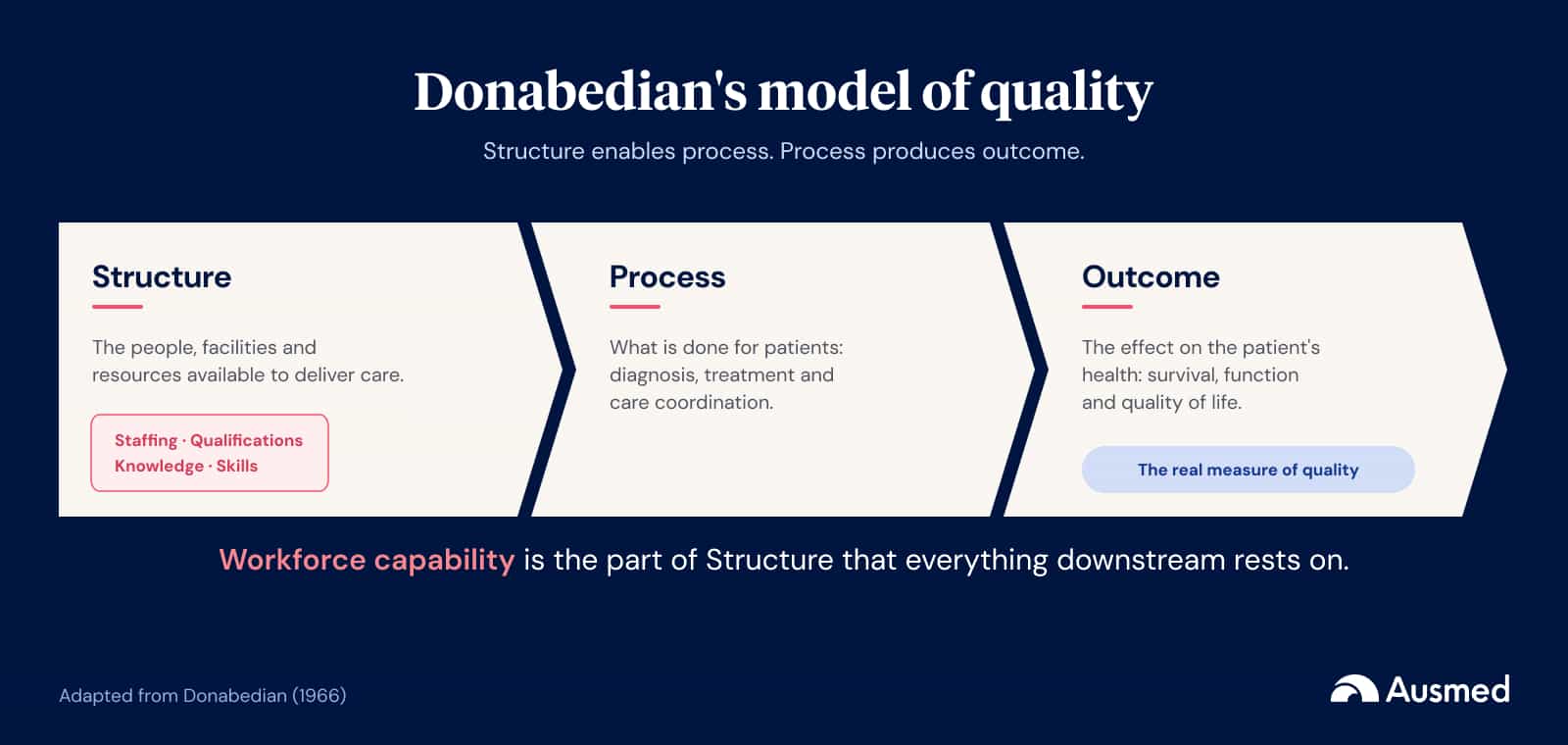
Donabedian (1966) gave us the language most quality frameworks still use: structure (the people, facilities and resources available to deliver care), process (what is actually done for patients) and outcomes (the effect on the patient’s health). His point was that outcomes are the real measure of quality. Notice where the workforce sits in that model. Staffing, qualifications, knowledge and skills are all part of structure, the foundation everything else rests on.
The patient safety movement gave the idea urgency. The 1999 US report To Err Is Human estimated that up to 98,000 Americans died each year from preventable medical errors (Institute of Medicine, 1999). In Australia, the Quality in Australian Health Care Study had already found that 16.6% of hospital admissions involved an adverse event (Wilson et al., 1995). Safety became a national priority, and with it the idea that health systems should be accountable for results.
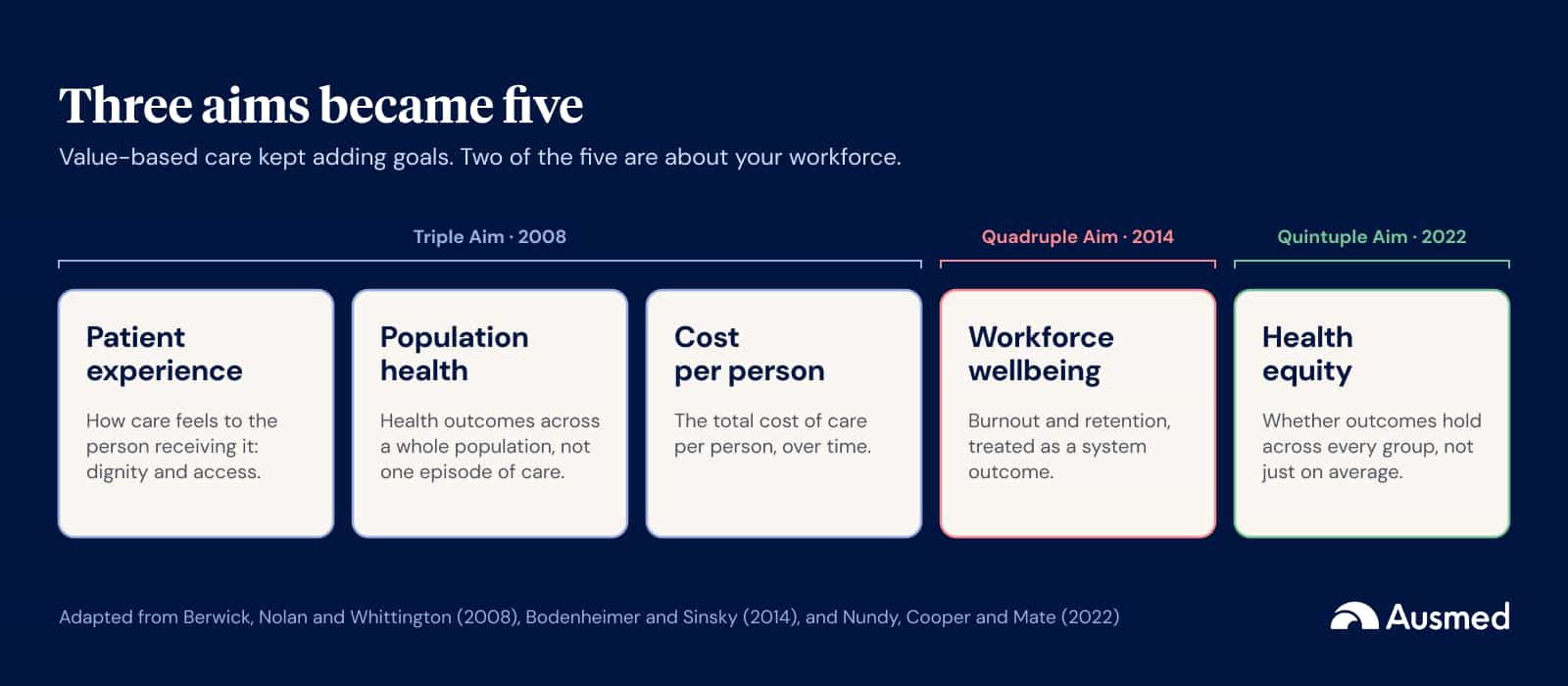
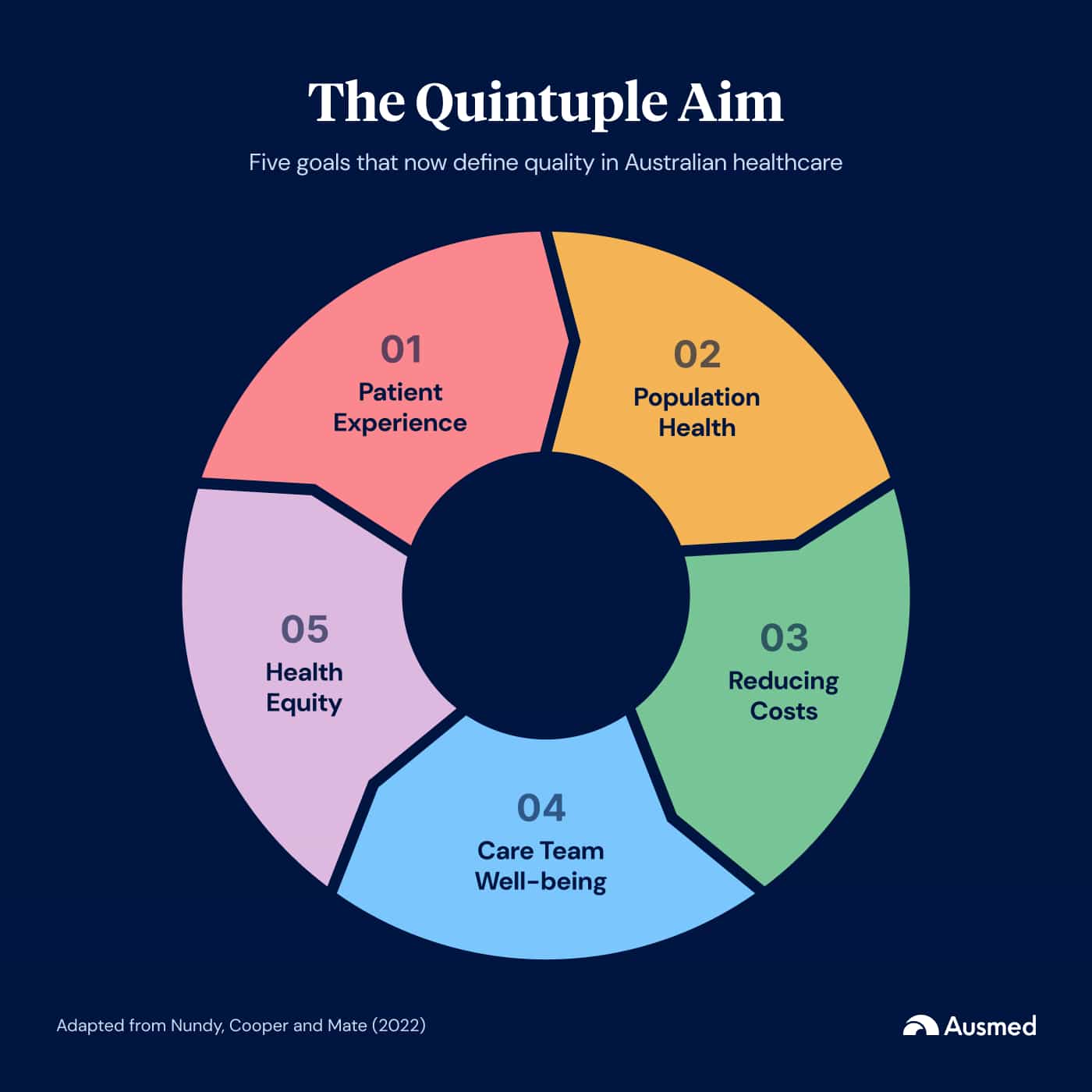
Then came the frameworks that shaped modern policy. The Triple Aim (Berwick, Nolan and Whittington, 2008) asked systems to improve patient experience, improve population health and reduce cost per person, all at once. It later grew into the Quadruple Aim, which added the wellbeing of the workforce, and then the Quintuple Aim, which added health equity. That progression matters. Workforce wellbeing is now treated as an equal partner to patient outcomes, not a side issue.
Where Australia is now
Australia’s path to value-based funding runs through decades of reform.
The move from block grants to casemix funding in the 1990s, pioneered in Victoria, was the first step. It let hospitals classify, cost and compare what they actually did. That became Activity-Based Funding (ABF), rolled out nationally by 2012. ABF was a real advance, but it paid for volume of activity, not the value of the result. That tension is still the central problem value-based care is trying to solve.
The turning point for hospitals came in 2018, when the Independent Health and Aged Care Pricing Authority introduced value-based funding adjustments into national ABF (IHACPA, 2018). Funding is now reduced for a defined list of Hospital Acquired Complications and for sentinel events. In plain terms, preventable harm carries a financial consequence, not just a clinical and human one.
The direction of travel is clear across the rest of the system:
| Milestone | What it did |
|---|---|
| National Health Reform Agreement (2011) | Set up national ABF and the first NSQHS Standards. |
| Value-based funding adjustments (2018) | Linked hospital payment to avoidable harm. |
| NHRA Addendum 2020-2025 | Named "paying for value and outcomes" as a core reform principle. |
| NSW Leading Better Value Care | Built condition-level outcome measurement and PROMs (Patient-Reported Outcome Measures) into practice. |
| AHPEQS patient experience survey (2018) | ACSQHC released the Australian Hospital Patient Experience Question Set, a national PREM (Patient-Reported Experience Measure) that captures how patients experienced their care, not just the clinical result. |
| NHRA Mid-Term Review (2023) | Recommended bundled payments and a 10-year national funding framework. |
By 2026, value-based principles will run through the National Health Reform Agreement, IHACPA’s funding model, the NSQHS Standards and state programs from New South Wales to Queensland to Western Australia. This is operational reality for hospitals, not a future scenario.
Why it matters for Hospital and Health Services specifically
The NHRA Mid-Term Review estimated that 30% of Australian health care is wasteful or low-value, and 10% is harmful (Huxtable, 2023). Much of that comes from care that varies when it shouldn’t: inconsistent application of the evidence, gaps in knowledge, preventable complications.
For a hospital, that translates into a practical question. How do you reduce the harm events that now attract funding adjustments, while improving the outcomes patients actually report? Better equipment and better systems help. But the people delivering care are where most of the answer sits.
The workforce is where value is made
Value in health care is produced by people. A capable, well-supported clinical workforce recognises deterioration earlier, prevents complications, communicates in ways that improve adherence, and speaks up about safety. A stretched or under-prepared one does the opposite. The evidence linking workforce to patient outcomes is some of the strongest in health services research (IQVIA, 2024), and it’s the subject of the next article in this series.
For now, the practical takeaway is this. If value-based care rewards outcomes and penalises avoidable harm, then building the knowledge, skills and engagement of your workforce is one of the most direct levers you have. That’s the capability layer, and it’s measurable.
Value-based health care asks a hard question of every hospital or health service: can you show the outcomes you achieve for what you spend? The workforce is where much of that answer is built.
References
Australian Commission on Safety and Quality in Health Care (ACSQHC), 2018. Australian Hospital Patient Experience Question Set (AHPEQS). Available at: https://www.safetyandquality.gov.au/our-work/indicators-measurement-and-reporting/patient-experience/about-ahpeqs/what-ahpeqs.
Australian Government, 2011. National Health Reform Agreement. Available at: https://federalfinancialrelations.gov.au/agreements/national-health-reform-agreement.
Australian Government Department of Health, 2020. National Health Reform Agreement Addendum 2020-2025. Available at: https://www.health.gov.au/our-work/national-health-reform-agreement-nhra.
Berwick, D.M., Nolan, T.W. and Whittington, J., 2008. The Triple Aim: care, health, and cost. Health Affairs, 27(3), pp.759-769.
Donabedian, A., 1966. Evaluating the quality of medical care. The Milbank Memorial Fund Quarterly, 44(3), pp.166-206.
Huxtable, R., 2023. National Health Reform Agreement Mid-Term Review: final report. Canberra: Australian Government Department of Health and Aged Care. Available at: https://www.health.gov.au/sites/default/files/2023-12/nhra-mid-term-review-final-report-october-2023.pdf.
Independent Health and Aged Care Pricing Authority (IHACPA), 2018. Safety and quality: value-based funding adjustments. Available at: https://www.ihacpa.gov.au/health-care/pricing/safety-and-quality.
Institute of Medicine, 1999. To err is human: building a safer health system. Washington, DC: National Academies Press.
NSW Health, n.d. Leading Better Value Care. Available at: https://www.health.nsw.gov.au/Value/lbvc/Pages/default.aspx.
Porter, M.E. and Teisberg, E.O., 2006. Redefining health care: creating value-based competition on results. Boston, MA: Harvard Business School Press.
Wilson, R.M., Runciman, W.B., Gibberd, R.W., Harrison, B.T., Newby, L. and Hamilton, J.D., 1995. The Quality in Australian Health Care Study. Medical Journal of Australia, 163(9), pp.458-471.