The first value-based health care guide in this series made the case that value-based care rewards outcomes and penalises avoidable harm. This one asks the obvious follow-up. What actually produces those outcomes?
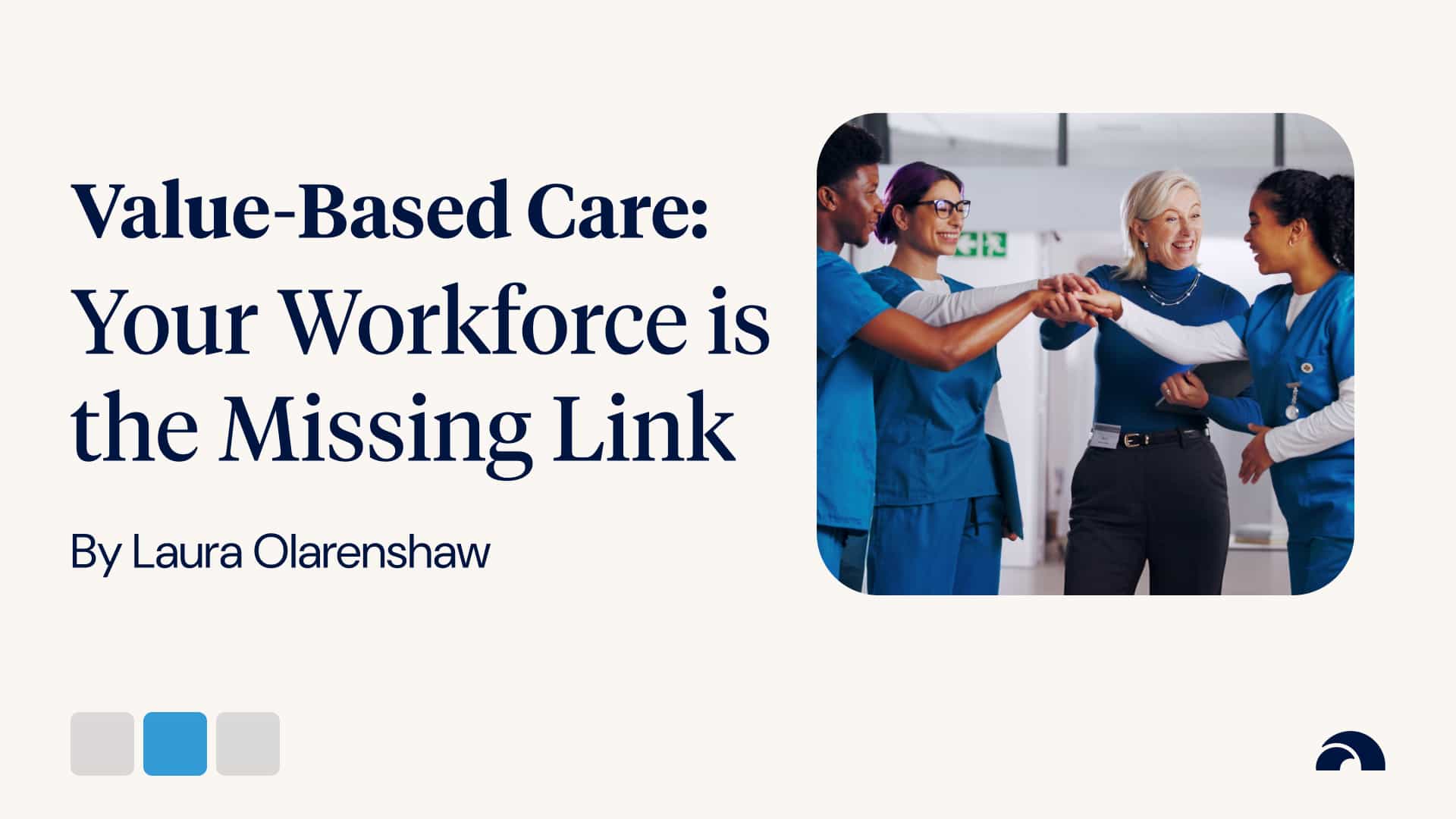
The answer, backed by decades of research, is people. Not systems alone, not equipment alone. The knowledge, skills and engagement of the clinical workforce sit at the centre of nearly every patient outcome that hospitals are now measured on. And the relationship runs both ways: the way staff are treated shapes patient results, and patient results feed back into how staff feel about the work.
The number that should stay with you
The landmark study on this is Aiken et al. (2002), published in JAMA. Among surgical patients, the researchers found that each additional patient added to a nurse’s workload was associated with a 7% increase in the likelihood of death within 30 days of admission. The same increase applied to failure-to-rescue, where a patient dies following a complication that should have been caught.
The mechanism is burnout. Each additional patient per nurse was also associated with a 23% increase in the odds of nurse burnout, and burned-out staff are less attentive, more error-prone, and slower to spot a deteriorating patient. Cimiotti et al. (2012) later connected higher burnout directly to more hospital-acquired infections. More than 100 studies since 2002 have confirmed the link between inadequate staffing and worse patient outcomes, including avoidable death. Read alongside the last guide, the point lands hard. Hospital-acquired complications now carry funding consequences, and workforce conditions are among the strongest predictors of whether those complications occur.
Engaged staff, better patient experience
Staffing levels are one-half of the picture. Engagement is the other. There is a correlation between facilities with a strong safety culture and higher staff engagement (Press Ganey, 2023). The reason is plain once you say it out loud. Engaged staff make the extra effort, know their patients as people, and are more willing to raise a safety concern. A single interaction with an engaged or disengaged staff member can shape a patient’s overall impression of a hospital.
Patient experience isn’t separate from clinical results. There’s a tendency to file patient experience under “satisfaction” and treat it as softer than clinical data. The evidence says otherwise. A systematic review by Doyle, Lennox and Bell (2013) found consistent links between positive patient experience and better clinical outcomes: higher treatment adherence, lower 30-day readmission rates, fewer adverse events and lower mortality across a range of conditions.
Patients also turn out to be good sensors of safety. Their reports pick up on hand hygiene, medication communication and discharge planning, the everyday behaviours that predict whether something goes wrong. This is why the NSQHS Standards now require the measurement of patient experience as part of clinical governance.
The cycle that ties it together
Put these findings side by side, and a pattern appears. It runs like this:
Workforce capability → clinical competence → care quality → patient outcomes → patient experience → staff satisfaction → workforce retention → and back to capability.
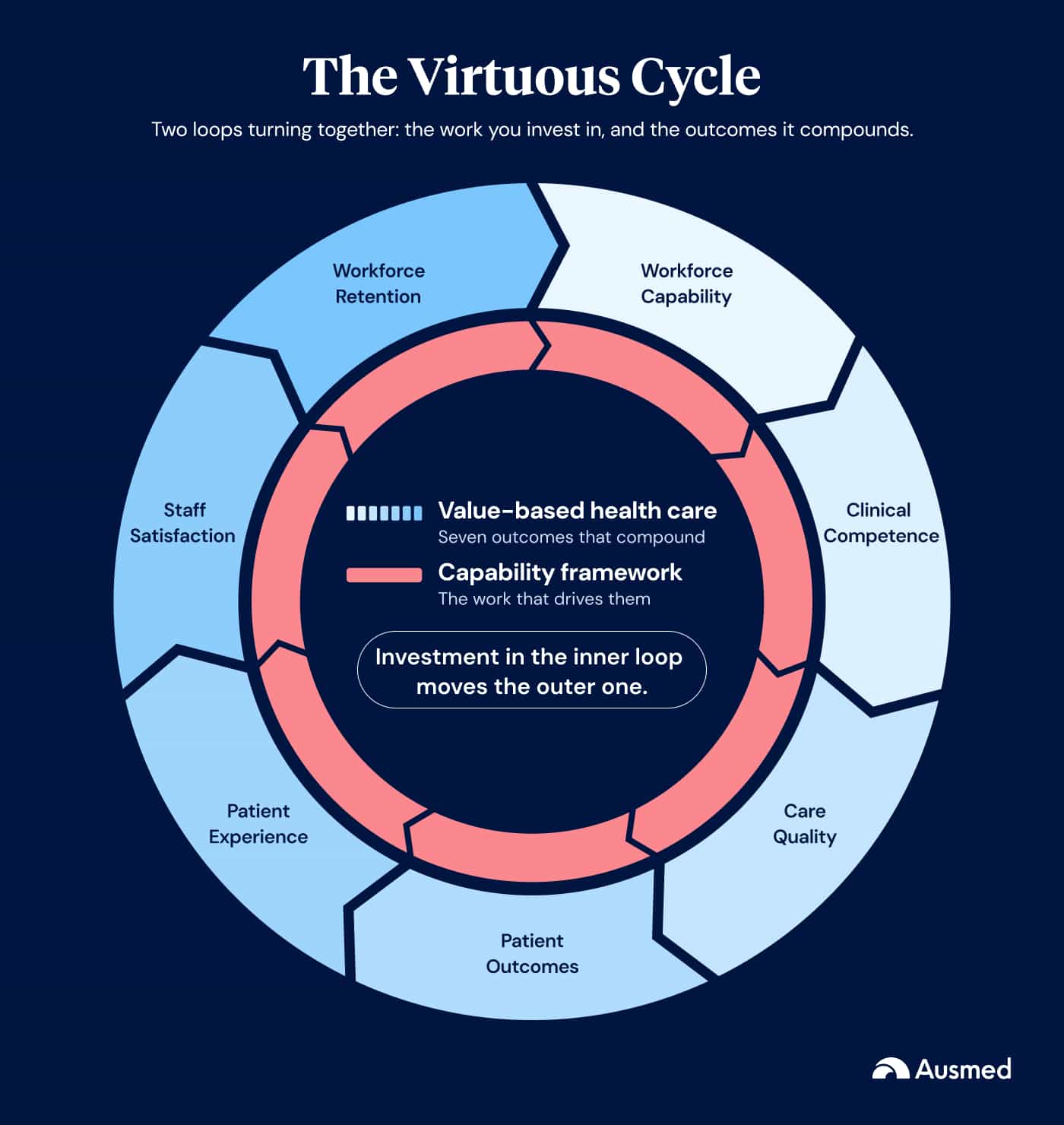
Invest in capability, and clinical competence rises. Competent care improves outcomes. Better outcomes and better interactions lift patient experience. A positive experience reinforces staff pride and professional identity, reducing turnover and protecting the capability you built. The cycle sustains itself.
It also runs in reverse. Under-prepared, disengaged staff deliver lower-quality care; patients do worse; staff carry the distress of falling short of their own standards; burnout and turnover rise; capability erodes. Breaking that reverse cycle is the work most Australian health and care organisations are now doing.
Where the lever actually is
Come back to Donabedian’s model of quality (Donabedian, 1966) from the first value-based health care guide. Workforce capability is structure, the foundation that determines what processes and outcomes are possible. You can’t measure outcomes that your staff don’t understand. You can’t deliver person-centred care without the communication skills to do it. You can’t run coordinated care pathways without teams capable of executing them.
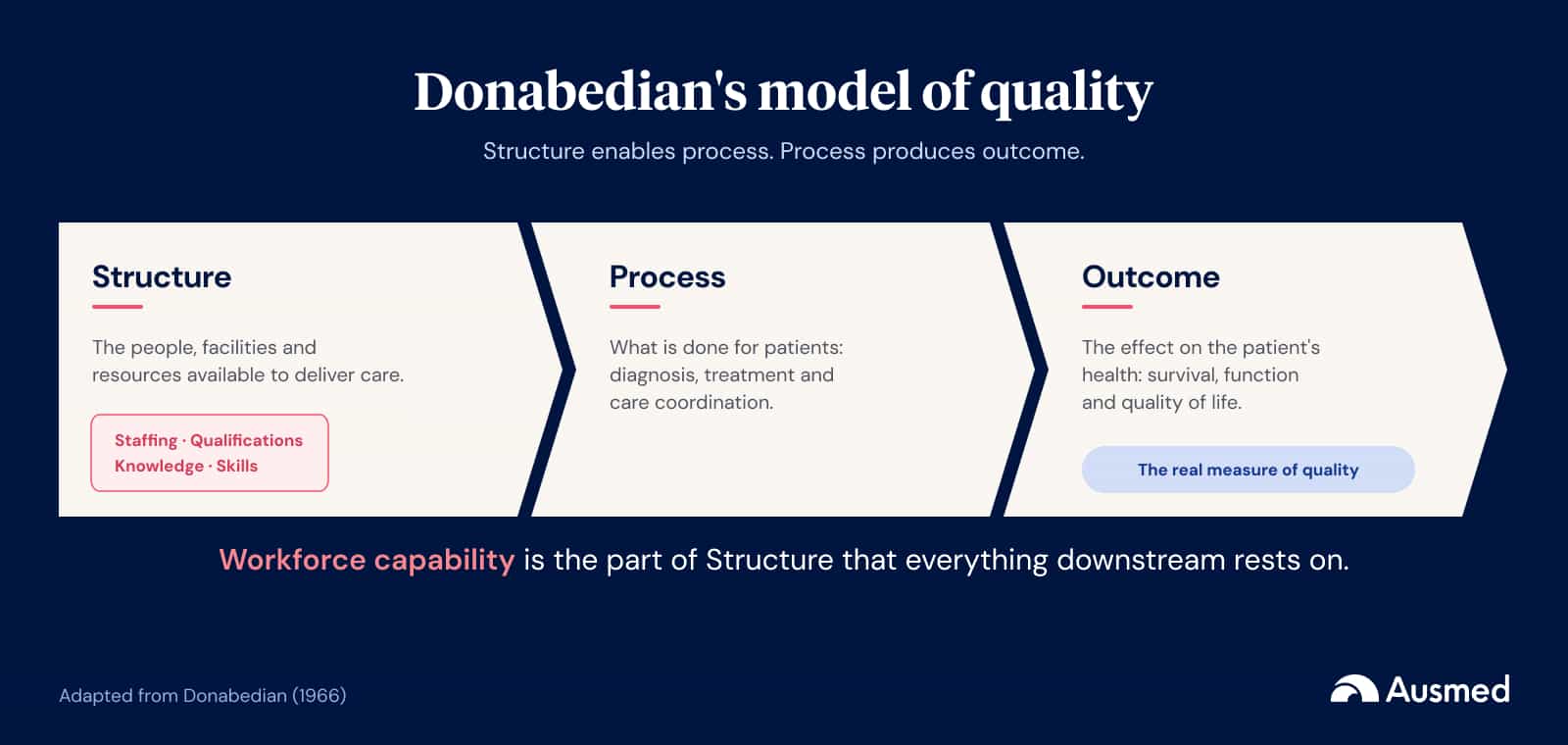
That makes capability a lever a hospital can actually pull. Budgets and labour markets constrain staffing numbers. Knowledge, skills, competencies, and engagement can be built deliberately, and their effects on outcomes are well-evidenced.
This is the ground Ausmed is built on. Ausmed Perform™ connects staff goals, feedback and recognition to learning, building the engagement. Ausmed Learn™ delivers the training that turns into clinical competence. Ausmed Competency™ will assess whether staff are demonstrably fit for their roles, and Ausmed Analytics™ makes the whole picture visible.
References
Aiken, L.H., Clarke, S.P., Sloane, D.M., Sochalski, J. and Silber, J.H. (2002) 'Hospital nurse staffing and patient mortality, nurse burnout, and job dissatisfaction', JAMA, 288(16), pp. 1987-1993. Available at: https://jamanetwork.com/journals/jama/fullarticle/195438
Cimiotti, J.P., Aiken, L.H., Sloane, D.M. and Wu, E.S. (2012) 'Nurse staffing, burnout, and health care-associated infection', American Journal of Infection Control, 40(6), pp. 486-490. Available at: https://pmc.ncbi.nlm.nih.gov/articles/PMC3509207/
Donabedian, A. (1966) 'Evaluating the quality of medical care', Milbank Memorial Fund Quarterly, 44(3), pp. 166-206. Available at: https://www.milbank.org/quarterly/articles/evaluating-quality-medical-care/
Doyle, C., Lennox, L. and Bell, D. (2013) 'A systematic review of evidence on the links between patient experience and clinical safety and effectiveness', BMJ Open, 3(1), e001570. Available at: https://bmjopen.bmj.com/content/3/1/e001570
Press Ganey (2023) Healing without harm: Safety culture trends 2023. Boston: Press Ganey. Available at: https://www.pressganey.com/resources/news/new-press-ganey-report-reveals-employee-perception-of-safety-culture-on-the-rise-even-as-leadership-and-physician-perceptions-slip/