A training matrix is the central spreadsheet that maps every mandatory and recommended learning requirement to every role, site, and frequency across your workforce.
Done well, it is the operating manual for your L&D function. Done poorly, it is a maintenance liability that creates more risk than it manages.
This guide walks through what a 2026 training matrix should look like under the Strengthened Standards (Aged Care Quality and Safety Commission 2025), the five mistakes that most often compromise matrices, a worked example for a residential aged care provider, and a downloadable XLSX template you can use as your starting point.
The Purpose of a Training Matrix
A training matrix has three jobs. It defines the required training, assigns it to the right people, and sets out how often each item needs to be completed. It's an organisational tool, not a learning record. The matrix tells you what's required and when it's due. The actual evidence that training happened sits elsewhere, in the completion and competency records themselves. For each of these jobs, the Strengthened Standards have raised the bar.
Training requirement definition is now Outcome-driven rather than topic-driven. Under the old Standards, you might have listed "Manual Handling" as a mandatory topic. Still, under the Strengthened Standards, you would list the relevant Outcomes (for example, Standard 5, Outcome 5.6 (Recognising and Responding to Deterioration)) and the training that satisfies each Outcome's evidence requirements for each role (Aged Care Quality and Safety Commission 2025).
Assigning training to the right people is now role-and site-specific. A registered nurse in a regional dementia-specialist unit has a different training matrix than a registered nurse in an urban general-care setting. Generic enterprise matrices are no longer considered best-practice and could be scrutinised in an audit.
The matrix itself is not the source of record. That evidence, training assigned, training completion, competency verified, supervisor sign-off, lives in your LMS and your competency system, wired together so you can produce it for any named staff member on demand.
This shift toward measurable, outcome-based evidence reflects the broader intent of the Aged Care Act 2024, which underpins the Strengthened Standards and was introduced in response to recommendations from the Royal Commission into Aged Care Quality and Safety (2021) for a more rigorous, person-centred regulatory framework (Aged Care Act 2024; Royal Commission into Aged Care Quality and Safety 2021).
The structure: rows, columns, and what goes in the cells
The simplest structure is a grid. Rows are Outcomes (or training topics within each Outcome). Columns are roles. Cells contain the frequency and the evidence type.
For a residential aged care provider, your row dimensions will include the Outcomes you mapped during your post-Strengthened-Standards review (Aged Care Quality and Safety Commission 2025). Your column will include (at minimum): Registered Nurse, Enrolled Nurse, Personal Care Worker, Lifestyle, Hospitality, Allied Health, Management, and Volunteer. Many providers add further role splits (graduate RN vs experienced RN, agency vs employed, etc.).
Each cell answers two questions. How often is this training required? (At induction, annually; biennially; on policy change.) And what evidence is required? (Module completion; competency observation; supervisor sign-off; knowledge verification.)
Knowledge Verification is a comprehension check that confirms a worker understood the training, not just that they completed it. It sits between completion and competency: completion tells you someone encountered the content, KV tells you they understood it, and competency tells you they can do it in practice.
Five mistakes that compromise most matrices
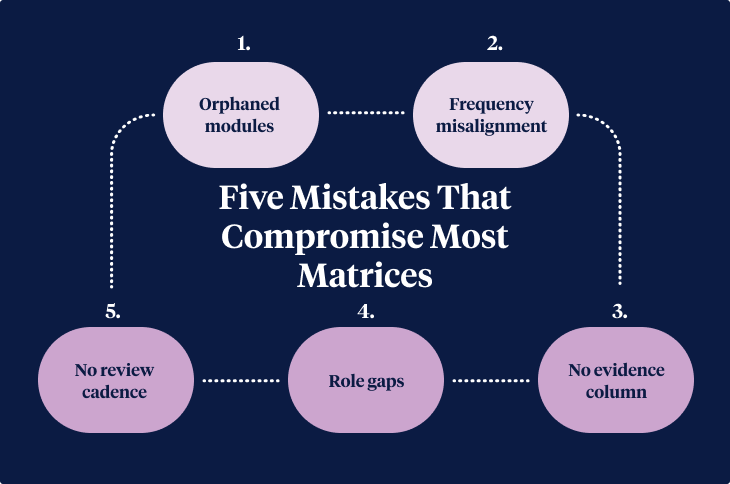
- Legacy modules with no current mapping. Training modules that aren't tied to any Outcome or risk driver are usually left over from a previous training priority that's since moved on. They sit in the matrix, taking up space and attention without doing any actual compliance work.
- Frequency misalignment. Topics assigned annually that should be triennial (e.g. general fire safety awareness), or biennially that should be annual (e.g. high-risk medication management). The frequency should reflect risk and currency, not historical convention.
- No evidence type specified. A matrix that defines what training is required but doesn't say what counts as done, module completion, competency observation, or supervisor sign-off. Without this, the matrix loses its value as a shared reference: different people end up assuming different things satisfy the requirement. What auditors actually want to see from a training matrix is that it defines what's mandatory, who it's assigned to, and how often it's required (Aged Care Quality and Safety Commission 2025). The evidence itself is produced and held elsewhere, in your LMS and competency system.
- Role gaps. Roles missing entirely from the matrix, typically lifestyle, hospitality, volunteers, and allied health. The Strengthened Standards apply across the whole workforce, not just the clinical core (Aged Care Quality and Safety Commission 2025).
- No review frequency. A matrix produced once and never revisited. A matrix that hasn't been checked against current requirements in the last 12 months is, by definition, out of date. The Commission itself reviews the Strengthened Standards on a five-year cycle to keep pace with best practice, and provider-level matrices should be reviewed far more often than that (Aged Care Quality and Safety Commission 2025).
A worked example: a 200-bed residential provider
For a 200-bed residential aged care provider, the matrix would typically include:
- Rows: approximately 35 to 45 Outcome-mapped training requirements
- Columns: 8 to 12 role categories
- Total cells: 350 to 500
- Review frequency: quarterly snapshot, annual full review
Below is an extract, just five rows and five role columns, to show the format.
| Outcome / Training | RN | EN | PCA | Lifestyle | Hospitality |
|---|---|---|---|---|---|
| 1.1 Person-centred care induction | Induction + annual KV | Induction + annual KV | Induction + annual KV | Induction + annual KV | Induction |
| 2.10 Emergency and disaster management | Annual + drill | Annual + drill | Annual + drill | Annual | Annual |
| 5.3 Medication management: administration | Annual + competency obs | Annual + competency obs | n/a | n/a | n/a |
| 5.5 Restrictive practices | Annual + scenario | Annual + scenario | Annual | Awareness | n/a |
| 5.6 Recognising deterioration | Annual + competency | Annual + competency | Awareness + escalation drill | Awareness | Awareness |
The full downloadable template includes all 30+ Outcomes, all role categories, and a separate evidence-tracking sheet.
Linking the matrix to your LMS
A matrix is only as good as its connection to the system that delivers training. The four signals of a healthy matrix-to-LMS link:
- Auto-assignment. When a new starter is added with a role and site, the LMS automatically assigns the right training.
- Overdue tracking. The matrix's frequency rules trigger overdue notifications to the staff member, their manager, and Quality.
- Evidence aggregation. For any named staff member, the system can produce a single export of training completed against each Outcome.
- Audit replay. The system can reproduce, for any past audit period, the exact training state at that time, not just the current state. This kind of replay capability matters because the Commission's own audit approach under the Strengthened Standards is risk-based and considers a provider's performance over time, not just its state on the day of assessment (Aged Care Quality and Safety Commission 2025).
A training matrix is a great organisational tool for planning and implementing a training schedule. It should assist you in assigning the right training to the right roles at the right frequency, but it needs to be reviewed at least annually.
How to use the downloadable template
The XLSX template contains four sheets:
- Sheet 1: Master matrix: the full grid of Outcomes × roles, with default frequency and evidence types pre-populated.
- Sheet 2: Role definitions: a glossary of role categories so you can adapt to your structure.
- Sheet 3: Evidence types: a definition of each evidence type (induction, annual completion, KV, competency observation, etc.) with example artefacts.
- Sheet 4: Review log: a quarterly review schedule with named owners and approval signatures.
Start by adapting the role columns to your structure, then walk through each row and confirm the frequency and evidence type. Where a cell is currently blank or marked as a gap, prioritise it in your L&D plan for the quarter.
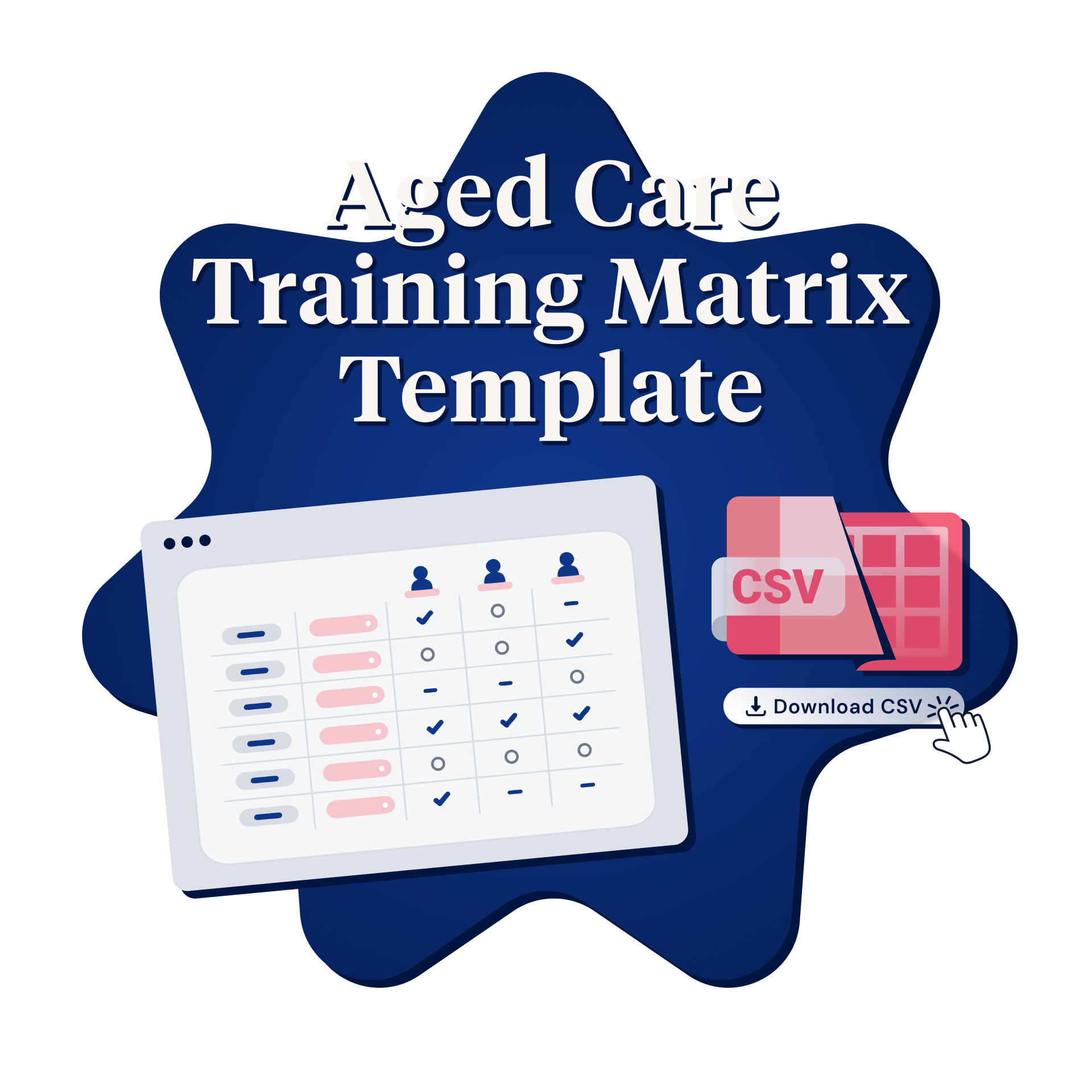
Aged Care Training Matrix Template
Get the full Outcome-mapped matrix, ready to adapt to your roles, sites, and review cycle. No more building it from scratch.
Download the free templateReferences
- Aged Care Act 2024 (Cth).
- Aged Care Quality and Safety Commission (2025) Strengthened Aged Care Quality Standards. Available at: https://www.agedcarequality.gov.au/providers/quality-standards/strengthened-aged-care-quality-standards
- Royal Commission into Aged Care Quality and Safety (2021) Final Report: Care, Dignity and Respect. Commonwealth of Australia.