
Most aged care providers can quote their turnover rate. Few can quote what it costs them.
That gap matters. The turnover number itself doesn't make the case for investment. The dollar figure does. And in 2026, the dollar figure for most providers is not just sobering. It is the single largest unaddressed cost line on their P&L.
This piece is a practical breakdown of what aged care worker turnover actually costs, the under-counted costs most providers miss entirely, the four retention levers backed by sector research, and how to put a defensible number in front of your board this quarter. To help you get there, we've built a free calculator that turns your own FTE count, turnover rate and average salary into that dollar figure. It's linked further down, once you've seen how the underlying math works.
The replacement-cost math
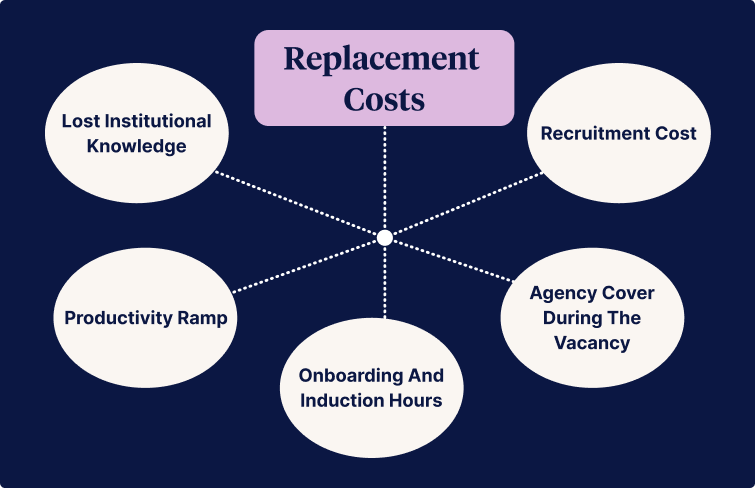
The replacement cost of an experienced aged care worker has five major components. Most providers calculate one or two and assume that is the total. The honest number is the sum.
1. Recruitment cost. Advertising, agency fees if applicable, time-to-hire of the recruiting manager. For an aged care worker, this typically sits at $2,500 to $8,000 per hire.
2. Agency cover during the vacancy. Most providers run agency cover for four to twelve weeks while filling roles. At $55 to $75 per hour through an agency versus $30 to $40 per hour fully loaded for an employee, this premium adds $5,000 to $20,000 per role.
3. Onboarding and induction hours. The hours your team spends inducting a new worker. Clinical educator time, supervisor floor time, training delivery, paperwork. For a new aged care worker, this is typically 30 to 50 hours of organisational time at fully loaded rates, around $1,500 to $3,000.
4. Productivity ramp. The new worker is productive at 50 to 70% of an experienced worker for the first three to six months. The shortfall is $5,000 to $15,000 depending on role.
5. Lost institutional knowledge. This is the under-counted one. When an experienced worker leaves, they take with them everything they knew about the residents they cared for, the colleagues they worked alongside, and the systems they operated. The cost shows up in incident rates, audit gaps and resident complaints in the months following the departure.
The 2026 sector benchmark
Annual turnover in Australian aged care sits at 30 to 40% across most providers.
Apply that benchmark. A 500-FTE provider with 35% annual turnover loses 175 staff per year. At an average replacement cost of $110,000, that is $19.25 million in annual turnover cost.
Most of that figure does not appear anywhere in a standard P&L. It is distributed across recruitment, agency, training, supervision, and clinical-incident-and-complaint lines. Each line looks individually manageable. The aggregate does not.
That aggregate figure is the business case.
Want your own number instead of the sector average? Plug your FTE count, turnover rate and average salary into the calculator below.
The under-counted costs
Even providers who do calculate turnover cost often miss four substantial components.
Sick-leave amplification during shortages. When you are short-staffed, the staff you have left work harder and burn out faster. Sick leave during high-turnover periods runs 30 to 50% higher than baseline.
Resident-care impact. Higher turnover correlates with measurably higher rates of falls, medication incidents, and complaints. The reputational and compliance cost is real but is rarely allocated back to its source.
Audit-evidence gaps. When staff churn, training records become inconsistent. The new staff member has different competencies than the one who left. Audit evidence packs require more reconstruction. This shows up as time, and as findings.
Manager burnout and turnover. High-churn frontline workforces drive manager turnover with a 6 to 12 month lag. The cost of replacing a clinical manager is significantly higher than replacing a frontline worker, and the gap is harder to close.
Add these to the headline replacement-cost calculation and the true cost of turnover in aged care is typically 20 to 30% higher than the standard models report.
The four retention levers
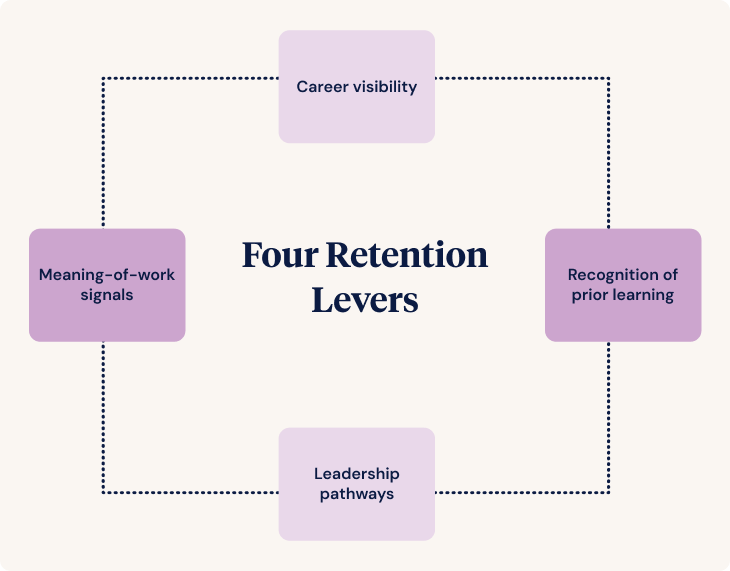
The good news is that retention is responsive to action. Aged-care-specific research consistently identifies four levers as the highest-impact.
1. Career visibility. Workers who can see what is next stay longer. Visible career pathways from PCA to EN to RN, or from frontline care to lifestyle leadership, drive measurably higher retention. The mechanism is simple: people invest in their future where they can see it.
2. Recognition of prior learning. Acknowledging what a worker already knows, through Knowledge Verification, portable learning records, or RPL credits, signals respect for their experience. Experienced workers who are re-trained on content they already know feel like they are being treated as inputs, not people. Those workers leave.
This is precisely the gap Ausmed Passport was built to close. It's a free, portable digital credential that lets an aged care worker carry proof of their completed mandatory training with them from one employer to the next. When a new starter arrives already holding a valid Passport, their induction training plan recognises it automatically, so they aren't re-sitting fire safety, infection control, or restrictive practices modules they've already passed elsewhere. For providers, that means faster time-to-productivity and lower onboarding cost per hire. For the worker, it means their prior learning is respected from day one rather than discounted.
3. Leadership pathways. Aged care workers who are explicitly identified as future leaders, given study support, and tracked through structured development plans, stay 2 to 3 times longer than peers without leadership signals.
4. Meaning-of-work signals. Aged care attracts workers for whom the work matters. Providers who explicitly connect the day-to-day work to the broader purpose, through resident-impact stories, mission-aligned recognition, and visible leadership commitment to quality of care, retain staff at significantly higher rates than peers who treat the work as a transactional service.
From spreadsheet to board
The single most consequential conversation a CPO or CHRO can have in 2026 is the one that puts the turnover-cost dollar figure on the board agenda.
The framing matters. Position the figure as a leading retention metric, not a lagging cost. Bring four supporting data points:
- Turnover cost per quarter, trended
- Top three drivers of voluntary departure (from exit interviews)
- Capability-development coverage by role (percentage of workforce with an active development plan)
- Recognition-of-prior-learning credits redeemed per quarter
These metrics belong next to financial performance and resident-experience data. They are the early signal of where the workforce, and therefore the business, is heading.
How to use the calculator
In the calculator, enter your own FTE, turnover rate and salary data (or start with sector defaults).
It produces your annual turnover cost modelled across three scenarios (Conservative, Sector mid-point and Upper range) so you can anchor the figure to whatever audience you're presenting to.
See what staff turnover is really costing your aged care organisation. It's more than just headcount.
Try the free Turnover Cost CalculatorUse it in two ways. As a board paper, drop the dollar number into your next workforce report. As an investment business case, when you ask for budget to invest in induction redesign, Knowledge Verification, or a capability platform, the calculator gives you the ROI denominator. If the investment costs less than 10% of your annual turnover cost, it is a defensible starting point for discussion, though your board should still test the underlying assumptions against your own data.
What good looks like
The providers leading on retention in 2026 share five characteristics:
- They quantify turnover cost quarterly and report it to the board.
- They invest in induction quality, not just induction completion.
- They have published, visible career pathways for every role.
- They run Knowledge Verification as standard practice for experienced staff.
- They link capability-development data to retention outcomes in their analytics.
References
Australian Government Department of Health (2021) 2020 Aged Care Workforce Census Report. Canberra: Department of Health. Available at: https://www.health.gov.au/sites/default/files/documents/2021/10/2020-aged-care-workforce-census.pdf (Accessed: 2 July 2026).
Bichard, M. (2024) 'Debate: Tackling the aged care workforce', Public Money & Management, 44(5). Available at: https://www.tandfonline.com/doi/full/10.1080/09540962.2024.2338998 (Accessed: 2 July 2026).
Fair Work Ombudsman (2026) Pay Guide: Aged Care Award [MA000018]. Canberra: Fair Work Commission. Available at: https://portal.fairwork.gov.au/ArticleDocuments/872/aged-care-award-ma000018-pay-guide.pdf.aspx (Accessed: 2 July 2026).
MedHireHub (2026) Aged Care Employment Agency: Casual, Temporary and Permanent Staffing in 2026. Available at: https://www.medhirehub.com.au/blogs/static/aged-care-employment-agency (Accessed: 2 July 2026).
Productivity Commission (2026) Report on Government Services 2026: Aged Care Services. Canberra: Australian Government Productivity Commission. Available at: https://www.pc.gov.au/ongoing/report-on-government-services/community-services/aged-care-services/ (Accessed: 2 July 2026).
Ristevski, E. et al. (2023) 'Factors impacting retention of aged care workers: a systematic review', Healthcare, 11(23), p. 3008. Available at: https://doi.org/10.3390/healthcare11233008 (Accessed: 2 July 2026).
Society for Human Resource Management (SHRM) (2023) The Myth of Replaceability: Preparing for the Loss of Key Employees. Alexandria, VA: SHRM. Available at: https://www.shrm.org/executive-network/insights/myth-replaceability-preparing-loss-key-employees (Accessed: 2 July 2026).
Willis, E. et al. (2024) 'The effectiveness of peer-led interventions to improve work-related psychosocial outcomes and reduce turnover of support workers in residential aged care: a systematic review and meta-analysis', International Journal of Nursing Studies. Available at: https://www.ncbi.nlm.nih.gov/pmc/articles/PMC11080450/ (Accessed: 2 July 2026).
Xiao, L.D., Kaak, V. and Yates, M. (2022) 'Fixing the aged care crisis won't be easy, with just 5% of nursing homes above next year's mandatory staffing targets', The Conversation, 21 July. Available at: https://theconversation.com/fixing-the-aged-care-crisis-wont-be-easy-with-just-5-of-nursing-homes-above-next-years-mandatory-staffing-targets-184238 (Accessed: 2 July 2026).