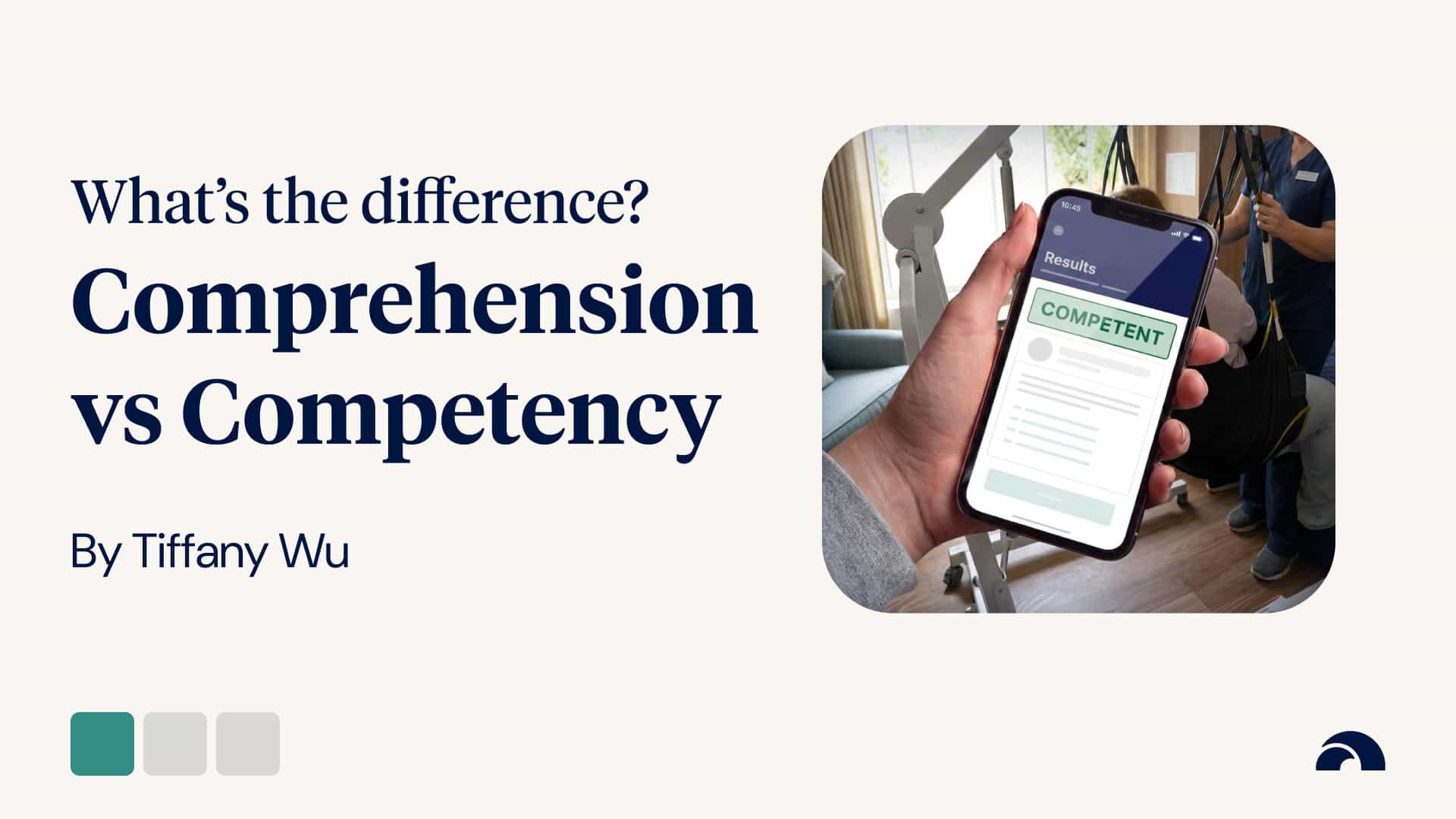
A staff member finishes the module, passes the assessment and maybe even scores full marks. None of that tells you whether they can perform what the module was about. This gap is why so many aged care providers walk into an audit holding a completion report that looks close to perfect and walk out with a non-conformance. What someone can explain and what someone can actually do are two different skills, measured two different ways, and mixing them up in your training records is where most of this trouble starts.
This article explores the distinction, what the research says about it, and what to actually change in your training matrix because of it.
Comprehension and competency are not the same thing
Comprehension is recall. A worker who can list the steps of a manual handling technique, or name the warning signs of clinical deterioration off the top of their head, has demonstrated comprehension. Fine. That still says nothing when at 2am an agitated resident has fallen and the hoist required is already in use down the corridor.
Competency only shows up when someone does the activity. The same worker actually completing the transfer safely with a resident present, or picking up on a deterioration and escalating it correctly midway through a shift that's already falling apart around them, that's competency. A quiz can't capture it. Nothing short of watching it happen can.
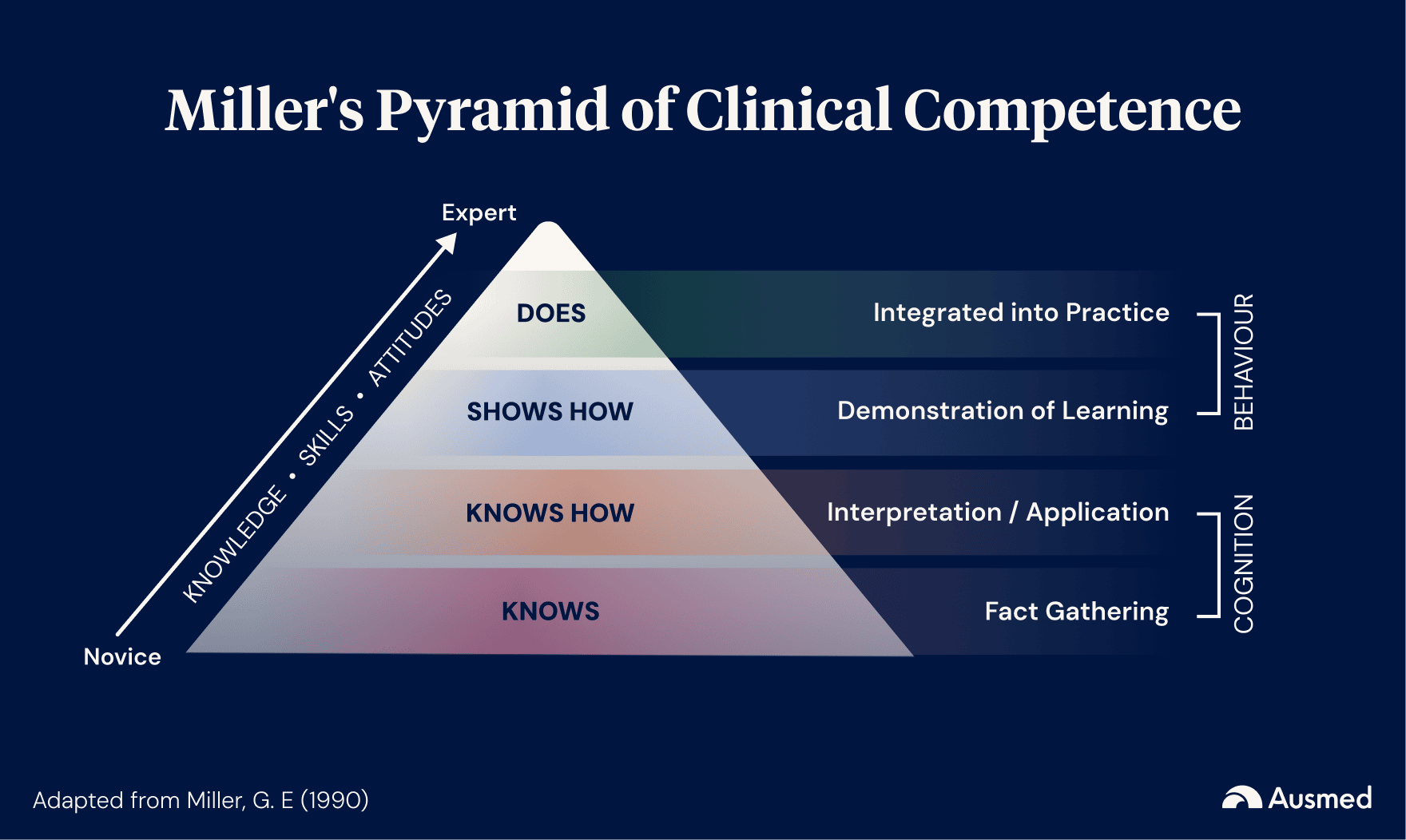
George Miller, a medical educator, put a name to this split in 1990 with what's since become known as the pyramid of clinical competence. Four levels, stacked: knows, knows how, shows how, does. The bottom two are comprehension, testable with a written question. The top two are competency, and there's genuinely only one way to check them, which is to watch the skill happen, in a simulation or for real (Miller 1990). His argument holds up more than three decades later and it's still blunt: knowing something is no guarantee you can do it (Miller 1990).
Why the Strengthened Standards draw this line
The strengthened Aged Care Quality Standards don't really leave room to falsify this. Standard 2, Outcome 2.9 covers human resource management, and the expectation is a training system that goes past course completion and actually demonstrates workers have the skills and competencies to do their job. Action 2.9.6 names specific core matters that need competency-based training rather than just awareness training, among them person-centred care, cultural safety, and the Serious Incident Response Scheme (Aged Care Quality and Safety Commission 2025). A completion certificate answers "did this person do the training." That is not the question the Standards are asking. They want to know if the person can do the job.
Most mandatory training programs never make it past that first, easier question. Completion-rate reporting is quick to generate and looks good in a board pack, so it becomes the default measure of whether training is working, even though it was never designed to answer that. A provider sitting on 98 percent completion has learned almost nothing about whether the workforce can perform under real conditions. Not the 2 percent who haven't finished the module, and not the 98 percent who have.
The evidence: knowledge does not reliably become practice
There's research behind this beyond the regulatory language. A review of reviews covering workforce training across long-term care for older people found that even where organisations got the conditions right, protected time, genuine chances to practise, learners still often failed to carry new knowledge into changed day-to-day practice unless something extra was deliberately built in to reinforce it (Newbould et al. 2022). Knowledge doesn't finish the job by itself. Leave out the step that checks whether a skill is actually being performed correctly and you're left with a training program that reads as airtight on paper while the floor tells a different story.
Which is also the case for figuring out where your competency gaps genuinely sit before spreading assessment resources evenly across every requirement you have. Some learning areas are new. Some are high-risk. Some trace back to an actual incident. Point competency assessment at those first. Spread the same level of scrutiny across everything regardless of stakes and you'll burn out your assessors on the low-risk stuff while the genuinely dangerous gaps get waved through with the same rubber stamp as everything else.
Matching the evidence type to the claim you are making
Ausmed Learn™, Ausmed's learning management system, is how Australian aged care and healthcare providers run training day to day. It includes Knowledge Verification™, which checks whether a staff member can recall and correctly apply policy, procedure and clinical knowledge through targeted, randomised questions. Staff who already know the material get the assignment marked complete on the spot, saving up to 65 percent of the time they'd otherwise spend resitting a module, while any gaps get routed straight into the full one. What it was never designed to do is confirm somebody performs a physical or clinical skill correctly when it counts.
That confirmation needs a different mechanism entirely: a supervisor or assessor physically watching the skill and signing off against a defined standard. Ausmed Competency™ is built around exactly that model, observed and signed off, and it maps to the Action 2.9.6 competency-based training requirement rather than sitting alongside it as an afterthought.
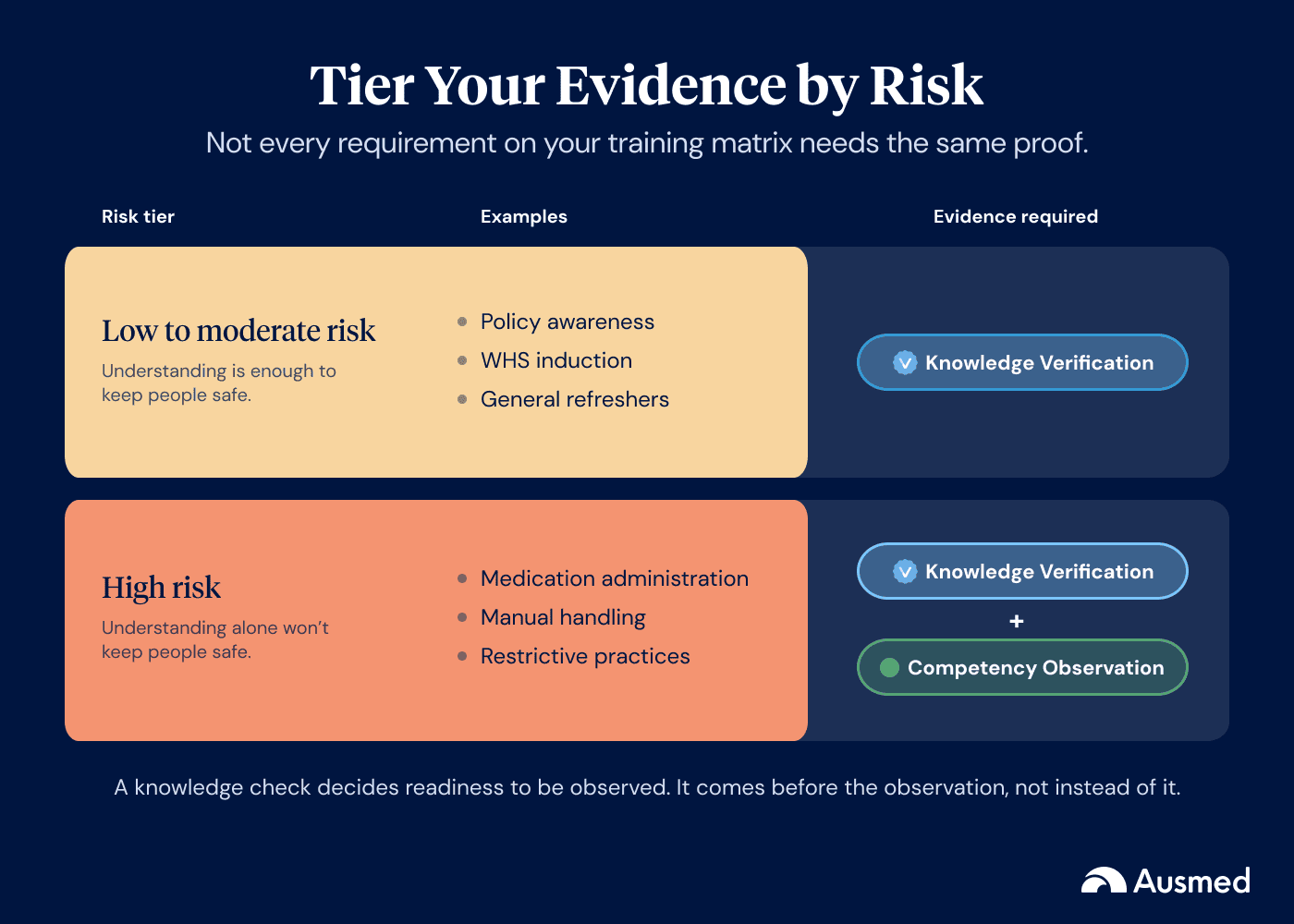
None of this is really about picking a winner between two tools. It's about matching the evidence to what the requirement is actually asking for. Policy awareness, WHS induction, general knowledge refreshers, a knowledge verification result covers those without argument. Medication administration, manual handling, restrictive practices minimisation are a different category, because a worker who understands the policy perfectly but can't apply it safely under pressure is exactly the failure mode the Standards were written to catch.
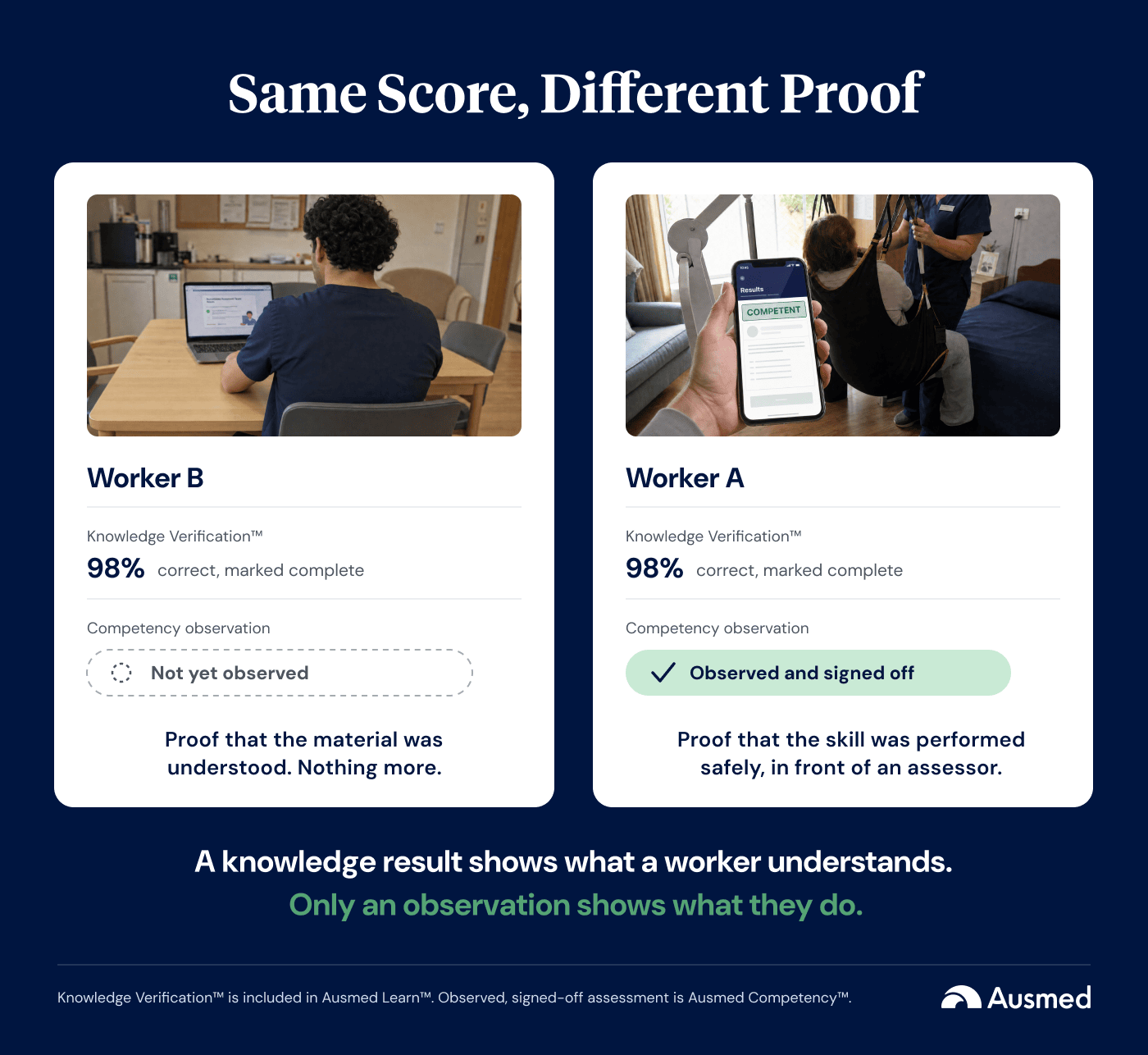
Two personal care workers complete the same manual handling module. Same knowledge check afterwards. Both score full marks. One can describe a two-person transfer in precise order, name every piece of equipment, explain exactly when a mechanical lifter replaces a manual technique. On paper, that's identical for both of them. Whether either one is actually competent is a separate question you can only answer by watching: does the transfer happen safely, does the worker talk to the resident the whole way through, do they recognise the point where they should stop and call for help instead of pushing on. Two identical quiz results can sit next to two very different levels of real-world safety, and if you only ever record the quiz, you've lost the one piece of evidence that would have told you which worker was which.
What assessors are actually looking for
During a site visit, assessors sample training and induction records across a cross-section of the workforce, agency and subcontracted staff included, then set what they find against what's actually happening on the floor (Aged Care Quality and Safety Commission 2025). This is the point where the comprehension-competency gap stops being an abstract distinction. An assessor opens a file, finds a completed module and a passed quiz, walks into a resident's room, and watches something else play out entirely. That doesn't read as a small training gap to them. It reads as a reason to start asking what else in the system might not hold up under a closer look, and that question rarely stays confined to the one skill they happened to catch.
Building both into your training system
If you're not already running one, a training matrix is the master record, usually a spreadsheet, that lists every training requirement against every role in your organisation, how often each one is due, and what evidence proves it actually happened. It's what turns everything above from a good idea into something you can actually run day to day and defend at audit. If you don't already have one, Ausmed's free training matrix template is a solid place to start.
None of the following requires doubling anyone's workload, which is usually the first objection raised when this comes up.
Tier requirements by risk rather than by whatever's easiest to run. A full competency observation isn't needed for every Outcome on your matrix. Reserve it for the skills where getting it wrong causes real harm, and let Knowledge Verification handle the rest without apology.
Make the evidence type explicit inside the matrix itself, not just implied by the training title. A cadence only tells you when something is due. It says nothing about what proves it actually happened, and that gap between "due" and "proven" is exactly where most matrices fall short.
And stop treating a passed knowledge check as the end of the process. Where a competency observation is required, use the knowledge result to decide whether someone is ready to be observed. It isn't a stand-in for the observation itself. It comes before it, not instead of it.
None of this calls for more training hours. It calls for being honest, in your own records and in whatever ends up in front of an audit about what each piece of evidence actually demonstrates. A completion record shows someone turned up. A Knowledge Verification result shows they understood the material. Only an observed, signed-off assessment shows they can do the job, and under the strengthened Standards, that's increasingly the bar providers are expected to clear.
Evidence comprehension and competency, in one system
See how Knowledge Verification™ in Ausmed Learn™ and Ausmed Competency™ work together to give you defensible evidence at every level, from knows to does.
Book a demoReferences
- Aged Care Quality and Safety Commission (2025) Strengthened Aged Care Quality Standards, Australian Government.
- Miller, G.E. (1990) 'The assessment of clinical skills/competence/performance', Academic Medicine, 65(9 Suppl), pp. S63–S67.
- Newbould, L. et al. (2022) 'Developing effective workforce training to support the long-term care of older adults: A review of reviews', Health & Social Care in the Community.