

Ausmed is a Trusted Information Partner of Healthdirect Australia. Verify here.


© 2026 Ausmed Pty Ltd (ABN: 33 107 354 441)
For home care providers registered in categories 4 and 5, Ausmed assigns each role the training your category calls for, records competency sign-off in the client's home, and reports by Standard while your workers are out on visits.
Book a walkthroughCategories 4 and 5 are the home care categories the Commission audits against the Strengthened Aged Care Quality Standards, when you apply to register, renew or extend. Standards 6 and 7 apply only to residential homes, so they never come into it.
Providers in registration category 4 must meet strengthened Quality Standards 1, 2, 3 and 4.
Providers in registration category 5 must meet strengthened Quality Standards 1, 2, 3, 4 and 5.
In Ausmed, each job role gets a training plan holding what your category requires and nothing written for residential care. Filter Ausmed Library™ by Standard and action to find the content, and read your coverage in the Regulatory Standards report.
If you are a category 4 provider that delivers care management or restorative care management, you also meet Outcome 5.1, Clinical governance. Assign that training to the roles that do the care management, and leave everyone else's plan as it is.
Standard 5 applies to all of category 5, and reaches category 4 only where you deliver care management. Training plans by job role give each worker what their service requires.
Who it applies to: Category 4 and category 5.
Training plans by job role, with coverage read by Standard in the Regulatory Standards report.
Who it applies to: All of category 5. In category 4, Outcome 5.1 only, and only if you deliver care management or restorative care management.
Clinical governance training for the roles that deliver care management, and clinical sign-off by an authorised assessor.
Who it applies to: Category 4 and category 5.
Infection prevention and control training by role, and practical skills an assessor signs off in the client’s home on a phone or tablet.
Who it applies to: Category 4 and category 5.
Training plans with reminders, and one-on-one meetings and probation reviews in Ausmed Perform™.
Who it applies to: Every worker, in both categories.
Library modules for the knowledge, and an Ausmed Competency™ sign-off for the practice.
Who it applies to: Every registered provider, its responsible persons and its workers.
Each worker acknowledges your Code of Conduct policy, by version, in Ausmed Policy™.
Who it applies to: On application, renewal and extension.
The Audit Report, which you scope to the teams and locations under review.
Filter Ausmed Library™ by Standard and action to see which resources map to the outcomes the Commission audits you against.
The Aged Care Library includes modules written for this setting, among them Strengthened Aged Care Quality Standards: Home Care and Annual Mandatory Training: Home and Community Care.
Add what you find to a role's training plan and it reaches the worker's phone in the Ausmed app. Training modules carry closed captions in eight languages for staff who speak English as a second language.
Explore the Aged Care Library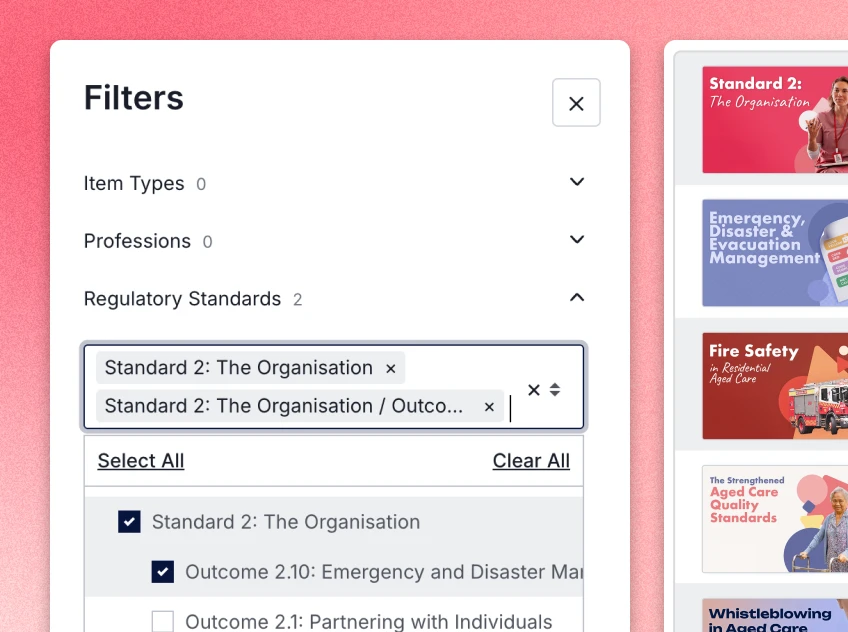
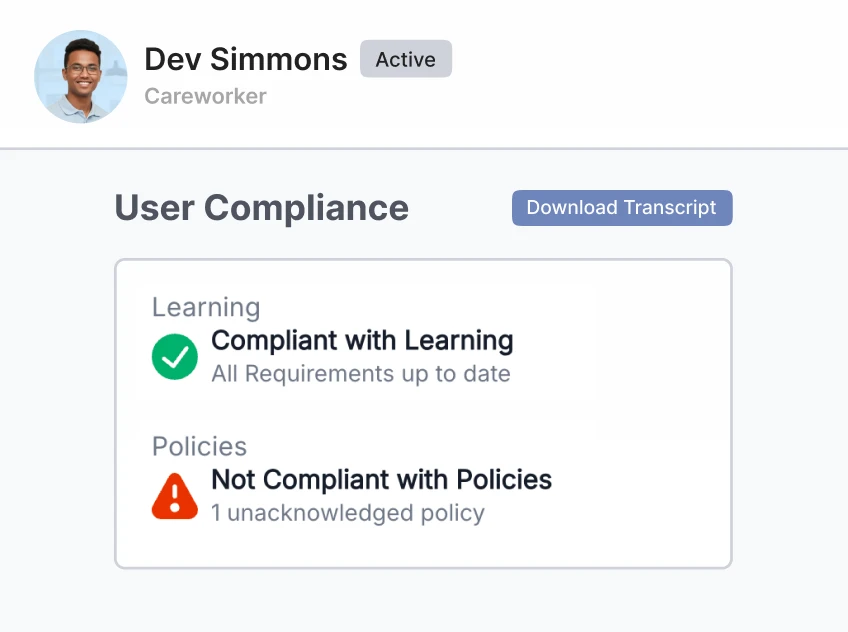
The Regulatory Standards report in Ausmed Learn™ maps learning records to the Strengthened Aged Care Quality Standards. Download training compliance by team, job role, location or Standard.
When an auditor asks about the workforce under Standard 2, you hand over the coverage against it, gaps included, and nobody rebuilds the report in a spreadsheet first.
Run it a few months before your renewal and the gaps are still yours to fix.
Compliance reportingEvery category 4 and 5 worker needs regular competency-based training in five core matters, and the Code of Conduct is one of them.
All aged care workers regularly receive competency-based training in relation to core matters, at a minimum: ... e) the requirements of the Code of Conduct, the Serious Incident Response Scheme, the Quality Standards and other requirements relevant to the aged care worker's role.
Ausmed keeps a separate record for each part of that evidence, all on the same worker's profile:
Ausmed Competency™ starts you from ready-to-use, observation-based templates, including ones for home and community care, and you can build your own against your procedures. You choose who is authorised to assess each competency.
The assessor opens the assessment on a phone or tablet in the client's home and marks each element as they watch. The record carries the assessor's name, a date and time stamp and comments.
You can see who is competent and not yet competent by team, role or location without waiting for paper to come back to the office.
In-person training and assessments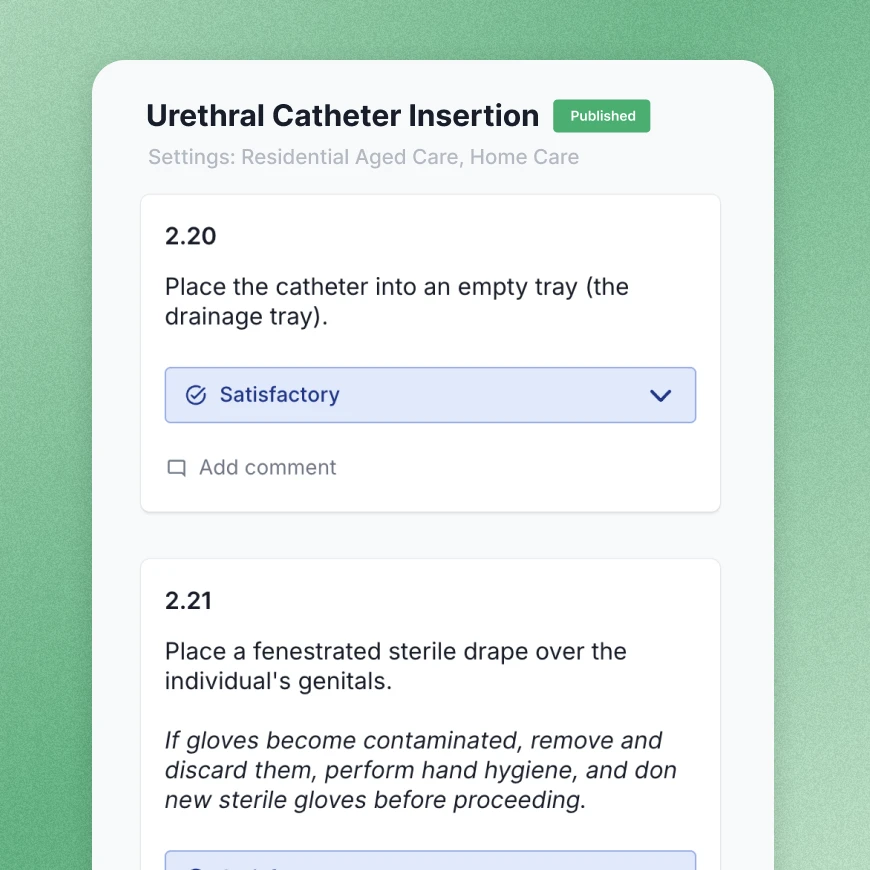
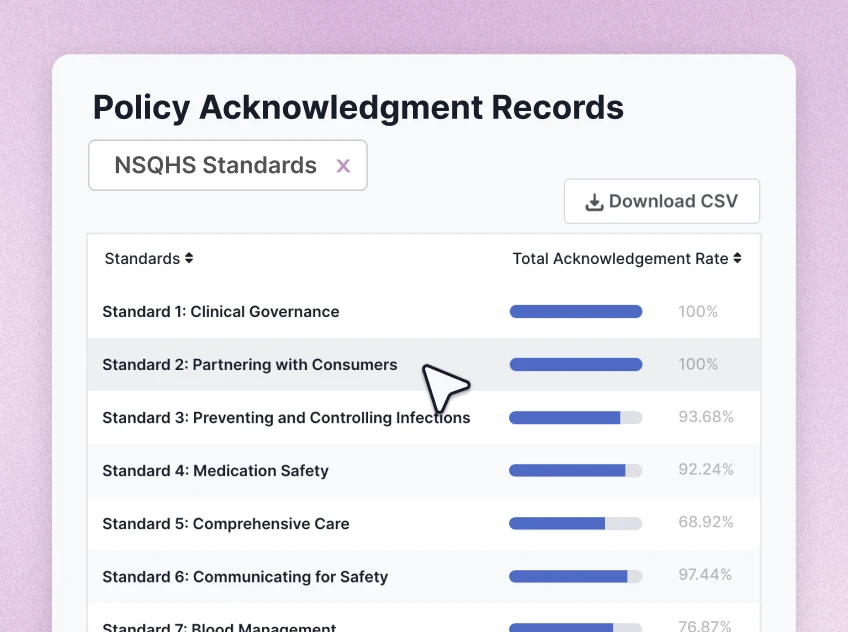
The Code of Conduct applies to every registered provider, its responsible persons and its aged care workers, which may include volunteers.
Load your Code of Conduct policy into Ausmed Policy™ and assign it to teams, roles and locations. Each worker acknowledges it on the web or on their phone, and the record shows who acknowledged it, when, and which version.
When you update the policy, earlier versions keep their history and you can ask staff to acknowledge the new one. The policy itself is yours to write. Ausmed holds it and shows who has read it.
Policies and proceduresOutcome 2.9 applies to categories 4 and 5. Action 2.9.3 asks for access to supervision, and Action 2.9.7 for regular review of each worker’s performance.
In Ausmed Perform™, a supervisor records one-on-one meetings, notes and feedback against the worker, whether the conversation happened on a home visit or by phone.
Review programs issue probation and annual, twice-yearly or quarterly reviews on schedule, and reports show what is due and overdue by team, location, job role and manager.
Performance and supervision
| Spreadsheets and paper | With Ausmed | |
|---|---|---|
| Which Standards apply | Someone works it out at registration, then keeps it in their head | Training plans set up for the roles in your category, and a report by Standard |
| Action 2.9.6 core matters | Module completions, with no record that anyone watched the work | Completion, plus a competency sign-off by a named assessor |
| Outcome 5.1 for category 4 | Easy to miss, because nobody flagged that care management brings it in | Clinical governance training for the roles that deliver care management |
| Code of Conduct | Signed forms in personnel files | Acknowledgement by worker, date and version |
| When the Commission asks | Hours of exports and spreadsheet work | A report by Standard, team, job role or location |

Training for the program your clients receive services under, by role and on the worker's phone.
Support at Home and CHSP
What an auditor asks to see for the workforce, action by action.
Audit preparedness
If you also run residential homes: all seven Standards, including 6 and 7.
Standards for residential careTell us your registration categories and we'll show you the Regulatory Standards report for the Standards the Commission audits you against.
Only Outcome 5.1, Clinical governance, and only if you deliver care management or restorative care management services. Otherwise category 4 providers must meet Standards 1, 2, 3 and 4.
The Commission lists audits against the Standards for categories 4, 5 and 6, on registration, renewal and variation. Categories 1 to 3 are not on that list.
The Code of Conduct still applies to every registered provider and its workers, and Ausmed records its acknowledgement the same way whatever your category.
No. Mapping shows which training covers which outcome and where the gaps are. The evidence an auditor weighs is what your workers completed, what an assessor signed them off on, and how your training system responds to what you find.
They took effect on 1 November 2025, the same day the Aged Care Act 2024 commenced and Support at Home began.
Ausmed is a Trusted Information Partner of Healthdirect Australia. Verify here.