

Ausmed is a Trusted Information Partner of Healthdirect Australia. Verify here.


© 2026 Ausmed Pty Ltd (ABN: 33 107 354 441)
For hospitals and day procedure services between assessments. Ausmed assigns training by role, records competency sign-offs on the unit and tracks reviews as they happen. The audit report you run the morning notice arrives is already complete.
Book a walkthroughSince 1 July 2023, accrediting agencies have assessed every public and private hospital and day procedure service against the NSQHS Standards at short notice. They assess each organisation once in every three-year cycle, at any point in it.
"From 1 July 2023, all public and private hospitals and day procedure services undergoing assessment to the NSQHS Standards" are assessed at short notice. "Organisations will generally have 24 hours-notice of their assessment commencing." "Some organisations will have 48 hours-notice."
The months of catch-up before an assessment are gone. Whatever the workforce record shows on an ordinary Tuesday is what the assessors see.
In Ausmed, that record stays current as the work happens. Ausmed assigns and re-assigns training by rule, and overdue items reach managers before an assessor finds them. Each sign-off and review lands on the staff member's record the day it happens.
With a day's notice, there is no lead-up to clear a backlog or find the folders. Ausmed keeps training, sign-offs and reports current day to day, so the record an assessor sees is the one you work from.

Hospitals used to clear overdue training in a push before assessment, and a push needs a week of reminders and roster time.
Ausmed Learn™ sends reminders as items fall due and escalates overdue ones to managers. No backlog builds up.

Paper sign-offs sit in unit folders and an educator's office, and finding them for a sample of staff is a search.
In Ausmed Competency™ the assessor records each sign-off on the unit against the clinician, and you find it by searching their name.

Assessors have to assess each hospital and day procedure facility in a group, and notice can come at any point in its cycle.
Site comparisons in Ausmed Analytics™ put every site on the same measures. The quality team knows which one is behind before its notice lands.

The trackers, and the knowledge of where things live, sit with one coordinator.
The Audit Report is a filter anyone with reporting access can run, so the evidence is there when the coordinator is on leave.

In three years staff turn over, roles change, and last cycle's figure stops describing the workforce.
User sync from your HR system moves starters, movers and leavers into the right training plans, and recurring assignment re-issues annual training as it falls due.

A not met finding brings 60 business days of remediation and a final assessment. If too many actions fall short at the initial assessment, a mandatory reassessment follows within six months.
Assign the remediation training or revised policy to the staff it applies to, and report completion by Standard as the 60 days run. The fix is on the record before anyone comes back.
Senior clinical executive, private day hospital group, 39 sites
An assessor can ask about one clinician, one unit or one Standard with a day's notice. In Ausmed, each request is a filter on the live record, and nobody compiles anything for the visit.
See it with your own dataThe Workroom lists who is overdue, for what, on which team, with reminders already sent and extensions recorded.
The Audit Report shows every requirement for one person, with status, timestamps, version history and links to evidence.
Report completion against each of the eight NSQHS Standards, and see gaps by team, role or location.
See each sign-off with the assessor, the date and time and the result, Not Yet Competent results and their action log included.
Ausmed Perform™ shows which staff in each unit have had their annual review and which are due.
Ausmed Policy™ records who acknowledged each policy, which version they acknowledged and when.
 NSQHS Standards, second edition · Action 1.20
Action 1.20 asks for a mandatory program that keeps running and a record that you monitor participation. Over three years that program has to survive staff turnover, role changes and annual refreshers falling due at different times for every person.
The health service organisation uses its training systems to:
a. Assess the competency and training needs of its workforce
b. Implement a mandatory training program to meet its requirements arising from these standards
c. Provide access to training to meet its safety and quality training needs
d. Monitor the workforce’s participation in training
Training plans in Ausmed Learn™ set the program by job role and location. User sync from your HR system puts each starter on the right plan, moves people when their role changes and removes leavers.
Recurring assignment re-issues annual training as each person's cycle comes round. The program in month 30 is the one you set in month one.
Monitoring runs all the time. Reminders go out as items fall due, and overdue items escalate to managers. The Workroom gives educators one list to send reminders, grant extensions and mark items complete with evidence.
When notice arrives, the participation report by NSQHS Standard is already up to date.
Automation and Efficiency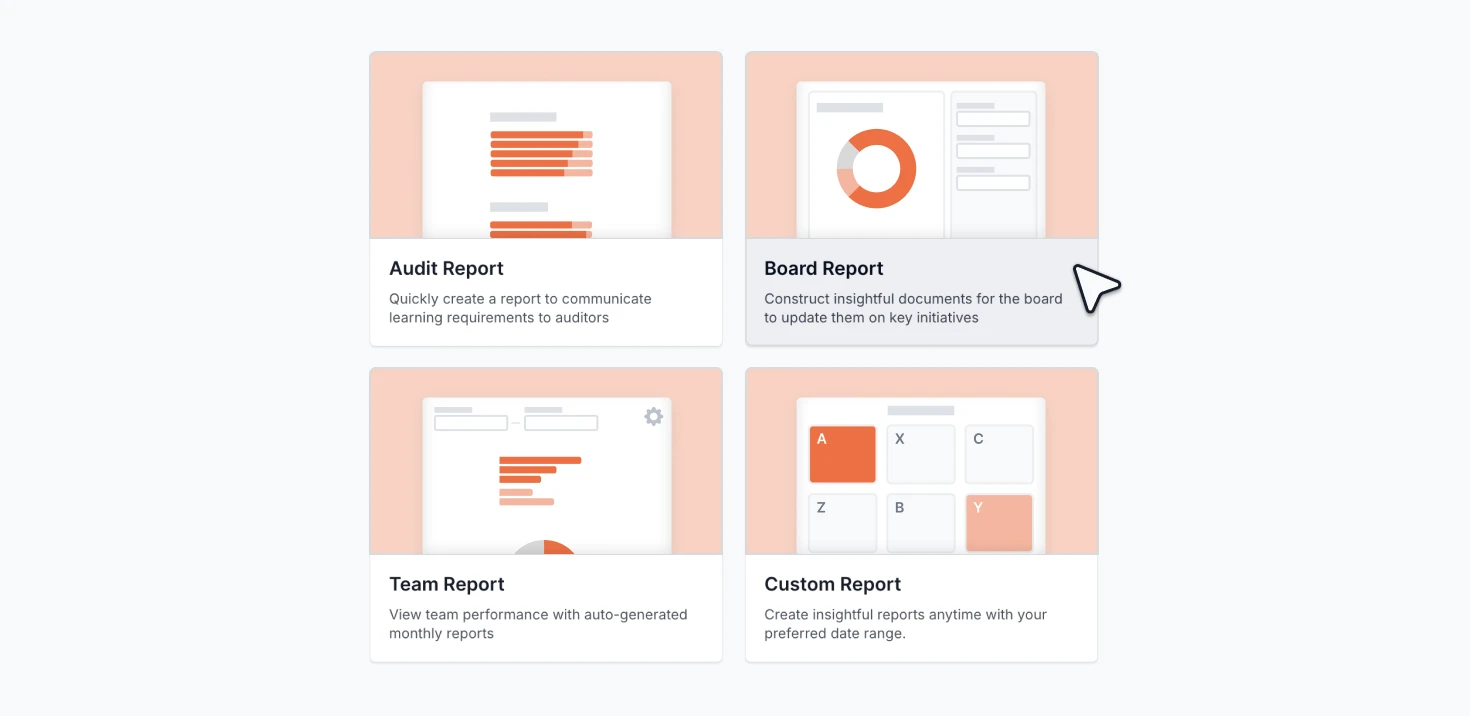
The Audit Report in Ausmed Analytics™ shows the status of every requirement for every person, with timestamps, version history and links to evidence. Filter it to the site being assessed, a team or a Standard, and export it as PDF or CSV for the assessor.
Between assessments, site comparisons put every hospital in a group on the same measures, and the Board Report tracks compliance quarter on quarter. A site that is slipping shows up months before its notice does.
Compliance reporting by ward, unit and facilityMove the competencies your wards already use into Ausmed Competency™. Assessors record each result on the unit in the assessor app, and Ausmed holds the sign-off against the clinician with the assessor's name, the date and time, comments and the result.
A Not Yet Competent result stays on file, with the follow-up recorded in the action log, so the record shows what happened before the pass. Dashboards show Competent and Not Yet Competent by team, role or location.
There are no Ausmed acute templates. You build your own from the forms you already use, so assessors judge clinicians against criteria they know.
Digitising paper-based competencies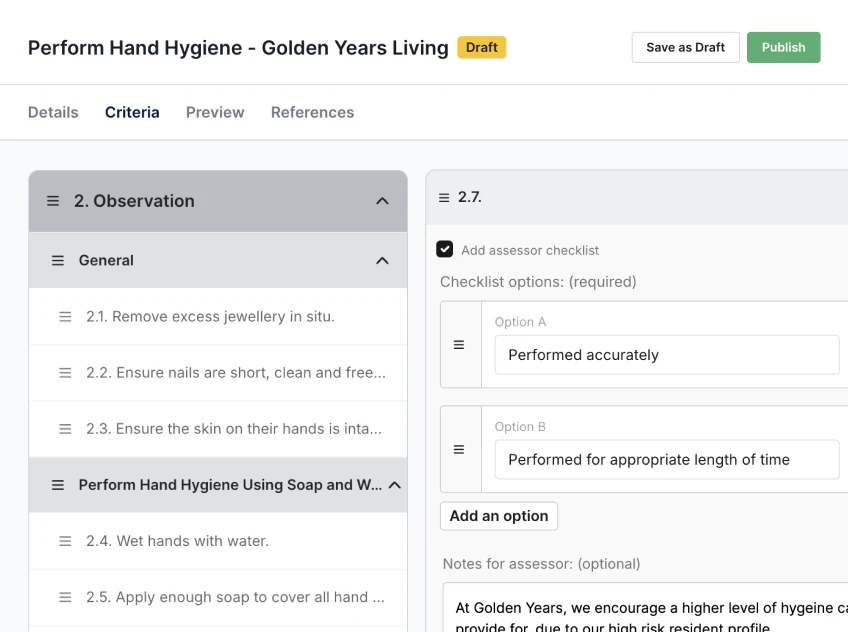
 NSQHS Standards, second edition · Action 1.22
Assessors sample performance review as well as training. Action 1.22 asks you to review members of the workforce regularly, identify training needs at those reviews, and carry those needs into the training system.
The health service organisation has valid and reliable performance review processes that:
a. Require members of the workforce to regularly take part in a review of their performance
b. Identify needs for training and development in safety and quality
c. Incorporate information on training requirements into the organisation’s training system
Ausmed Perform™ schedules probation programs, annual appraisals and catch-ups against each person. The manager records the conversation in notes, with evidence files attached.
A training need raised at the review sits on the same staff record as the person's training plan, where the educator assigns the follow-up.
When notice arrives, Perform shows which staff in each unit have had their review and which are due, from the platform that holds their training and competency record.
Discover Ausmed Perform™Training plans, user sync and recurring assignment keep the mandatory program current across the three-year cycle.
Ausmed Learn™Run the Audit Report, reports by Standard and site comparisons, ready to filter and export on the day.
Ausmed Analytics™Record sign-offs on the unit and hold them against each clinician, Not Yet Competent results included.
Ausmed Competency™Pick a ward, and we'll run the audit report an assessor would see if notice arrived tomorrow.
Generally 24 hours, meaning one full business day, for metropolitan, regional and rural services with public transport. Rural and remote services with limited transport get 48 hours. Where permission to enter is needed, notice is two to four weeks.
A service can also ask to exclude up to 20 business days in each cycle.
In Ausmed, the audit report runs from the live record, so you spend the notice period reviewing the evidence.
A remediation period of 60 business days, then a final assessment, which is announced.
In Ausmed, assign the remediation training or revised policy to the staff it applies to, and report completion by Standard while the 60 days run. The evidence of the fix is in place before the final assessment.
When actions rated not met and met with recommendations together make up 16% or more of all assessed actions, or when eight or more actions in the Clinical Governance Standard are not met. The service is reassessed within six months of the assessment being finalised, and the reassessment is announced.
Assessors look again at every action rated not met or met with recommendations, for evidence that the changes have been embedded. Any action still not met gets 60 business days of remediation and a final reassessment, and every action must be met or met with recommendations to keep accreditation. The Commission's Fact sheet 3 sets out the process.
The workforce actions, from Action 1.19 to Action 1.24, sit in the Clinical Governance Standard. In Ausmed, the training, competency, review and policy records behind them stay current between assessments, so a gap shows on a report well before an assessor rates it.
Anyone you give reporting access can run the Audit Report, filtered to a site, team or Standard. Reporting lines set who reports to whom, so a nurse unit manager can pull their own unit's record without waiting for the quality team.
Not yet. Accrediting agencies assess against the second edition now, and Ausmed content and Standards reporting map to it.
The draft third edition consolidates the eight Standards into three. Consultation closed on 25 September 2026, with a pilot in 2027, final release in 2028 and assessment from 2030.
Ausmed is a Trusted Information Partner of Healthdirect Australia. Verify here.